Loading

COP30 Brasil Radio Bulletin
COP30 Brasil Bulletin #35 - COP30 President defends evolution of climate multilateralism towards a two-speed model and accelerated implementation
In a new letter to the international community, Corrêa do Lago warns that the future of climate governance depends on the evolution of multilateralism amidst worsening geopolitics. Listen to the report and learn more.
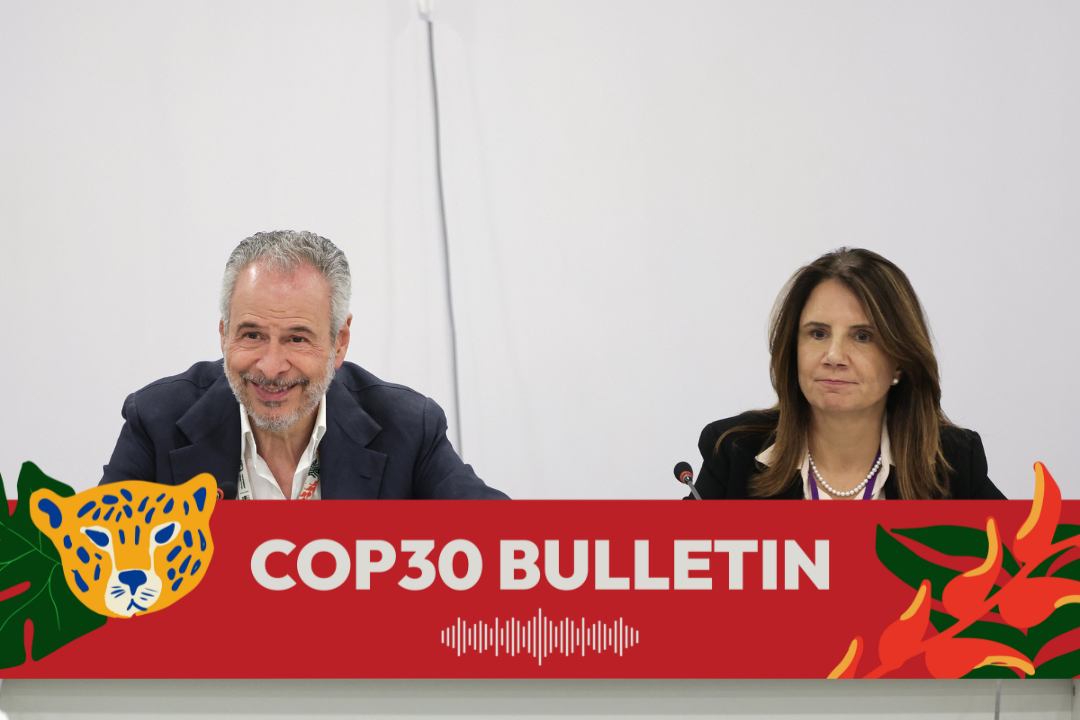
Report: Leandro Molina/COP30
Voice-over: Bárbara Menezes
Reporter: The COP30 President, Ambassador André Corrêa do Lago, has released the first Presidential Letter of 2026. The document underscores two pivotal messages: that the global climate transition is now irreversible, and that multilateralism must evolve to meet the urgent demands of a warming planet.
He contends that COP30 demonstrated that climate action can no longer be confined to negotiation rooms. Under the guidance of President Lula, the Brazilian initiative introduced an unprecedented and necessary debate regarding the world’s reliance on fossil fuels—the primary drivers of roughly 70 percent of greenhouse gas emissions. The Ambassador noted that while the multilateral system was not yet prepared to codify this discussion formally, Brazil took it upon itself to develop strategic roadmaps for transitioning away from fossil fuels and for halting and reversing deforestation.
André Corrêa do Lago: The Ambassador states that the Brazilian COP Presidency is coordinating efforts with both Australian and Turkish counterparts. These roadmaps are being developed in collaboration with a broad array of institutions and nations. He emphasizes that the roadmaps for fossil fuels and the cessation of deforestation by 2030 are mandates established in Dubai; however, as progress has stalled, the Brazilian Presidency has moved to accelerate the pace.
Reporter: The letter further asserts that climate multilateralism is not in crisis, but rather in a state of maturation. To keep pace with global warming, the system must operate at two speeds: one rooted in international consensus, and another focused on accelerated implementation—capable of mobilizing governments, corporations, finance, and civil society. For the COP30 President, international cooperation remains the only viable path to confront the climate crisis.
André Corrêa do Lago: Mr. Corrêa do Lago highlights an additional forthcoming roadmap, which will detail the second phase of mobilizing USD 1.3 trillion annually starting in 2035 to finance climate policies across the developing world. He maintains that Brazil’s role is to unify not only its own nation but the global community, reinforcing that collective efforts must keep the climate discourse at the center of all agendas.
Reporter: In the letter’s final assessment, President André Corrêa do Lago points out that 56 decisions were adopted by consensus, coinciding with the tenth anniversary of the Paris Agreement. More than 130 countries presented updated climate targets, or NDCs. The conference also consolidated advances in adaptation, finance, the inclusion of Indigenous people, and climate justice, alongside the launch of the Global Implementation Accelerator. To read the twelfth Presidential Letter in its entirety, access cop30.br webpage.
English version: Trad. Bárbara Menezes