
Mutirão Examples
COP30’s mobilization demonstrated, in practice, how the Global Mutirão can connect the international climate regime to people’s everyday lives. Throughout 2025, numerous initiatives — led by communities, subnational governments, civil society organizations, and youth networks — translated climate action into concrete, inclusive experiences distributed across different territories.
Thematic Mutirões with Global Reach

Across every continent, thematic mutirões mobilized thousands of people around shared environmental causes. Communities organized cleanups of beaches, rivers, and mangroves for World Cleanup Day; cities and collectives promoted World Car-Free Day, encouraging alternative forms of mobility; digital campaigns raised awareness of mangroves, coral reefs, and coastal ecosystems.
Other initiatives, such as the Mutirão for Sustainable E-Waste Management, drove global mobilizations to promote proper e-waste disposal and strengthen the circular economy, resulting in the collection of 1,050 tonnes of e-waste — five times the initial target. These actions showed how global observance days can serve as catalysts for local mobilizations that drive everyday behavioral change.
Mobilization in Brazil
States and local partners organized the Biome COPs, creating spaces for dialogue and mobilization dedicated to the country’s ecosystems. Local tree-planting mutirões demonstrated in practice society’s engagement with ecosystem regeneration.
Civil society promoted debates, workshops and educational activities, engaging traditional communities, students, environmental movements and scientific institutions. These gatherings strengthen the link between science, local knowledge and public policy, broadening understanding of climate challenges and solutions in each territory.
Self-Managed Ethical Dialogues

Communities, social movements, youth networks and local governments independently organized dialogues on the ethical dilemmas of climate action.
The inspiration comes from the Paris Agreement’s Global Stocktake, but viewed through the lens of promoting ethical, planetary listening on the climate crisis — bringing together social, cultural, spiritual, business, scientific, and political leaders to discuss the ethical reasons behind the difficulties in advancing efforts to address it.
These gatherings featured diversity across gender, race and generation, with strong participation from Black women, Indigenous peoples, Afro-descendant communities and local collectives. The dialogues reinforced the importance of justice, equity and inclusion as pillars of the climate response.
Youth Mutirão

Youth networks organized dozens of events before and during the conference in Belém, expanding the presence of peripheral, Indigenous and disabled voices within the COP30 agenda.
More than 50 consultation processes were carried out in Brazil through territorial plenaries, complemented by international engagement during Climate Weeks and other global forums. The mobilization also included a trilingual participation platform, which connected youth contributions to the COP30 Action Agenda and reached hundreds of thousands of people through digital content.
MiniCOPs and Intergenerational Leadership
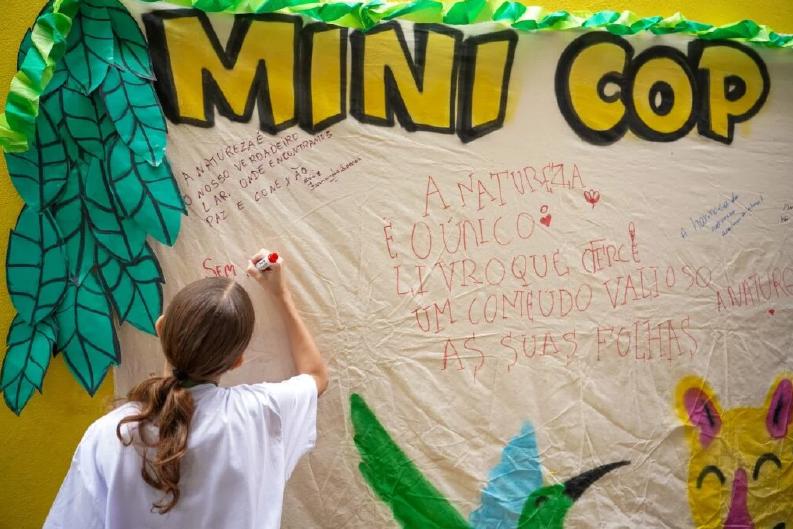
Among the most innovative examples of the Mutirão was the organization of 130 MiniCOPs, which mobilized children and adolescents in ten countries. Through conversations, workshops, and hands-on activities, these spaces allowed participants to express their perceptions and proposals on the climate crisis.
During COP30, more than 170 children took part in official activities, including high-level intergenerational dialogues, making Belém one of the most participatory climate conferences for this audience. The MiniCOPs, developed by Instituto Alana with support from the COP30 Presidency, became a model of mobilization that integrates education, dialogue and climate action.
A Mosaic of Actions
These examples demonstrate that the Global Mutirão does not take shape as a single initiative, but rather as a mosaic of actions connected by a shared purpose. Together, these experiences show how distributed mobilization—rooted in territories and globally connected—can strengthen the implementation of the Paris Agreement and expand the reach of climate action in an inclusive, concrete, and continuous manner.
Looking for Mutirão examples to organize in your territory?

1)Tree Planting and Reforestation Mutirões
- Organize groups for planting native trees in urban and rural areas.
- Restore degraded areas, riverbanks, and slopes.
- Partner with schools, NGOs, and universities.

2)River, Beach, and Public Space Clean-Up Mutirões
- Remove solid waste from natural areas
- Sort waste for recycling
- Collect data on types of litter for awareness campaigns

3)Composting and Urban Garden Mutirões
- Establish community and school gardens
- Set up collective composting points for organic waste
- Share agroecological and permaculture techniques

4)Environmental Education Mutirões
- Conduct workshops, discussion circles, and film screenings on the climate crisis
- Create educational spaces in underserved neighborhoods
- Bring information, debates, and climate action to public schools

5)Sustainable Mobility Mutirões
- Encourage the use of bicycles and public transportation
- Organize groups for bike rides and campaigns for bike lanes
- Promote carpooling and public transport route mapping

6)Neighborhood Zero-Waste Mutirão
- Conduct environmental education workshops focused on waste separation
- Carry out door-to-door selective waste collection routes
- Set up exchange points for recyclables in return for seedlings or food
- Hold workshops on making eco-bags and reusing waste materials

7)Energy-Conscious Mutirões
- Organize visits to exchange regular bulbs for LEDs
- Install flow reducers on taps
- Conduct workshops on how to reduce energy consumption at home

8)Water-Conscious Mutirões
- Conduct visits to homes and businesses to identify leaks
- Promote the installation of simple cisterns or rainwater harvesting systems
- Organize discussion circles about the region’s rivers and springs