
COP with record indigenous participation secures territorial protection and mechanisms to strengthen the agenda
Approximately 5,000 members of original peoples from around the world participated in COP30; 360 of them were present in debates with negotiators within the Blue Zone
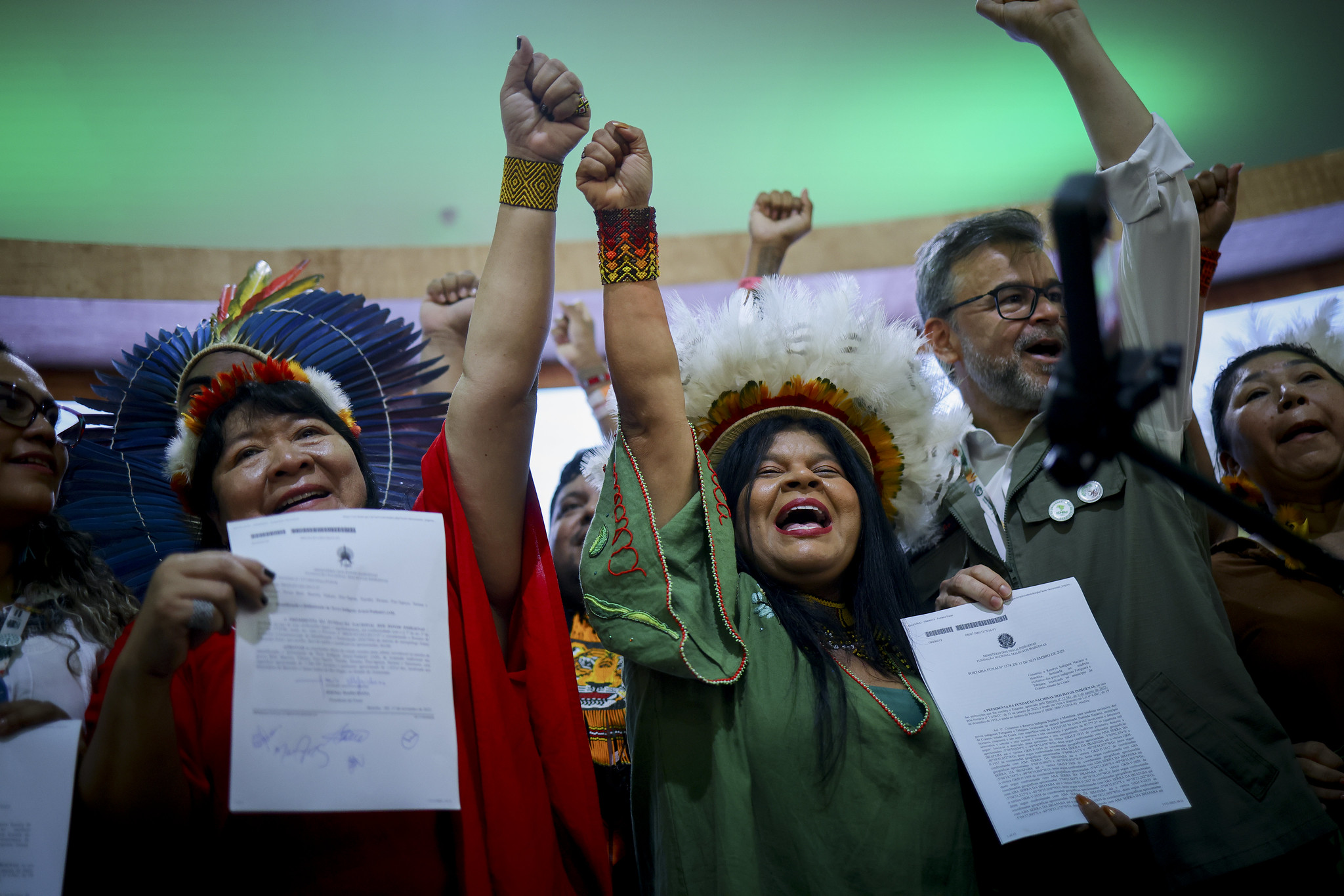
With information from the Ministry of Indigenous Peoples, Laura Marques/COP30
The 30th United Nations Climate Change Conference (COP30), held in Belém, Pará, hosted at least 5,000 Indigenous individuals who participated in debates in various capacities, according to the Indigenous movement in dialogue with the Ministry of Indigenous Peoples (Ministério dos Povos Indígenas/ MPI). The Ministry also reported that approximately 3,500 members of the original population were accommodated at the Aldeia COP (COP Village), a large structure set up at the Federal University of Pará (UFPA).
Indigenous groups led the conference agenda through a variety of actions —including debates with negotiators in the Blue Zone, the unprecedented Peoples' Summit, and the Circle of Peoples Pavilion in the Green Zone, presided over by Minister of Indigenous Peoples Ms. Sonia Guajajara. Ms. Guajajara stressed that President Luiz Inácio Lula da Silva's establishment of the MPI granted Indigenous autonomy in several areas and was pivotal in ensuring a robust Indigenous presence at the COP.
“This is a joint construction to put Indigenous people at the center of the political debate to ensure effective participation beyond mere quantity,” the Minister affirmed, noting that 360 Brazilian Indigenous people formed part of the Brazilian delegation in the Blue Zone. Previously, the record attendance for global Indigenous representatives at a COP was 350, registered at the Dubai COP. Additionally, approximately 500 delegates from other Indigenous organizations and Indigenous people from other countries attended the COP30 Blue Zone.
According to the MPI, Belém itself was taken over by an enormous diversity of peoples and languages and brought visibility, recognition, and prominence to the issue through concrete announcements. Important examples include the creation of environmental financing funds, such as the Tropical Forests Forever Fund (TFFF), and the signing of the Intergovernmental Commitment on Land Tenure by several countries, including Brazil. Also noteworthy was the Brazilian government's approval of four indigenous territories and the demarcation of ten Indigenous lands.
“Indigenous peoples came to Belém seeking the demarcation of Indigenous lands because it is our priority and our strategy for confronting the climate crisis. It was the Indigenous voices at the conference, the articulations of the MPI and FUNAI, and all the preparation that brought us these achievements,” assessed the President of FUNAI, Ms. Joenia Wapichana.
The Executive Coordinator of the Articulation of Indigenous Peoples of Brazil (APIB), Mr. Kleber Karipuna, emphasized that Brazil achieved a record attendance mark. “It will be very difficult for this Indigenous presence to be surpassed at future COPs. I am grateful for the commitments made to protect 63 million hectares of Indigenous and Quilombola territories in Brazil,” he stressed.
Aldeia COP (COP Village)
The structure housed members of 385 different peoples from around the world. Of these, 312 were Brazilian, and 73 were from 42 other countries. In total, the space received 10,000 visitors, according to the MPI.
“Faced with the mobilization to bring thousands of Indigenous people to Pará, we decided to create our own village to overcome the issue of high accommodation costs. The Aldeia COP became our space for meeting, debate, dialogue, and spirituality to ensure that those who are confronting the climate crisis are not ignored. For the first time in the history of the Conferences, the Indigenous agenda took the center stage of the debate,” celebrated Minister Sonia Guajajara.
“I think we managed to inform those who came to visit us something we have been saying for a long time: we are the answer for keeping the forest standing,” added Ms. Concita Sompré, President of the Council of Regional Articulators of the Federation of Indigenous Peoples of Pará.
COParente and Kuntari Katu
The 360 Indigenous individuals who worked in the Blue Zone were selected through the COParente Cycle: a series of pre-COP30 events held by the MPI to prepare leaders and inform these populations about the functioning and relevance of the conference.
Of the total, 32 Indigenous people were participants in the Kuntari Katu course, which the MPI organized this event in partnership with the Rio Branco Institute and Brazil’s Ministry of Foreign Affairs (Itamaraty) to train Indigenous leaders to influence global governance.
Other Advances
During COP30, the MPI launched the Manual for Activation and Response in Land Conflicts Involving Indigenous Peoples. The document is an unprecedented tool developed by the ministry in partnership with the World Bank as part of the Land Restitution and Peace building in Indigenous Territories project. The publication aims to guide indigenous leaders, public servants, and institutions through the procedures involved in land disputes.
The Ministry also published the report during the Conference Undermining Rights: Impacts of Mining on Indigenous Peoples and the Climate, in partnership with the Latin American Faculty of Social Sciences (FLACSO). The text portrays three cases of conflicts involving mining in the Amazon and concludes that the activity encroaches upon traditional territories with serious violations of Indigenous rights.
Beyond this, the National Foundation of Indigenous Peoples (Funai) instituted the Indigenous Tourism, Ecotourism, and Ethnotourism Seals. The three seals attest to the offering of a visitation service that meets safety and sustainability requirements, having adopted good territorial and environmental management practices.