
A program for recovering degraded areas will be among the initiatives presented at COP30
The Brazilian federal government will present an initiative in Belém as part of national efforts to meet climate targets and strengthen food security
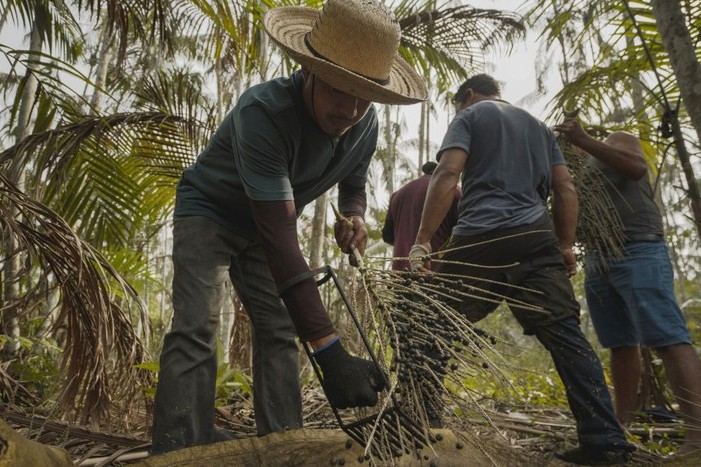
By Rafaela Ferreira/COP30 Brasil
The National Productive Forests Program (Plano Nacional de Florestas Produtivas/PNFP) will feature among the initiatives presented at COP30, to be held in Belém, Pará, from 10 to 21 November. The program aims to restore degraded areas for productive use and encourage the environmental regularization of family farms, thereby increasing the production of healthy food and socio-biodiversity products.
Coordinated by the Ministry of Agrarian Development and Family Agriculture (Ministério do Desenvolvimento Agrário e Agricultura Familiar/MDA) and the Ministry of Environment and Climate Change (Ministério do Meio Ambiente e Mudança do Clima/MMA), the PNFP seeks to tackle national challenges such as increasing the food supply and strengthening income generation for rural families. The initiative also contributes to Brazil’s commitments under the 2015 Paris Agreement, which calls for reducing greenhouse gas (GHG) emissions within the framework of sustainable development.
According to Ms. Fernanda Machiaveli, Executive Secretary of the MDA, the program’s purpose is to capture carbon, value the communities that preserve forests, and promote food security and national sovereignty. “We needed to address land regularization while offering an alternative that would generate income for families to promote the restoration and recovery of altered or degraded areas, but productively, based on the principles of regenerative agriculture,” she stated.
The program targets family farmers, including those from agrarian reform settlements and traditional and Indigenous territories. In addition to food production and income generation, the initiative contributes to national and international climate goals. Ms. Machiaveli highlights that, during COP30, the idea is to take delegations to visit some of the projects as part of a strategy to disseminate technologies: “In our action plan, one of the initiatives is the PNFP. It’s an alliance among tropical forest countries to promote preservation through the implementation of co-associated systems,” she explained.
Furthermore, she notes that the program plays a key role in Brazil’s Nationally Determined Contribution (NDC) under the Paris Agreement. The Brazilian NDC includes the National Native Vegetation Recovery Plan (PLANAVEG), which aims to expand and strengthen public policies, financial incentives, markets, and recovery technologies to restore 12 million hectares of native vegetation by 2030.
Sustainable agri-food production
The program is based on Technical Assistance and Rural Extension (ATER) for beneficiary families, focusing on sustainable agri-food production and the development of collective infrastructure for production chains. Another key element is the Pronaf Floresta credit line, which facilitates productive restoration in a quality and efficient manner. The updated line increases the financing limit from BRL 80,000 to BRL 100,000 and reduces the interest rate from 4% to 3% per year.
The program also includes the creation of community nurseries, spaces equipped with seed banks and seedling production for use by beneficiary families. Finally, popular technology reference units will serve as demonstration plots for family practice and training.
Ms. Machiaveli notes that the PNFP integrates various fronts of social and technological innovation: “One of them is the establishment of reference units for agroforestry systems—structures that communities can visit and use, serving as inspiration to replicate agroforestry practices on their own lands. There is also technical assistance throughout the entire process. Another technology included is the development of nurseries with seeds and seedlings in each community, enabling the production needed to replicate the reference units,” she explained.
“We are also implementing the so-called ‘Forest House’, a training space dedicated to sharing knowledge and experiences. In addition to contracted technical assistance, we have the participation of Embrapa (Brazilian Agricultural Research Corporation), which monitors the entire process,” she added.
Investments
According to the results of the Amazon Fund Call for Proposals for the period 2025–2029, the program has already received BRL 150 million in investments in productive forests, covering the states of Amazonas, Acre, Rondônia, Mato Grosso, Tocantins, Pará and Maranhão. The initiative will benefit 80 agrarian reform settlements, home to 6,000 families, and will restore 4,600 hectares of degraded land. Funding comes from the MDA, the MMA, and the BNDES.
English Version: Trad. Bárbara Menezes.
Proofreading by Enrique Villamil.