Homechevron_rightUN Secretary-General calls for immediate action on methane emissions
Global Action
UN Secretary-General calls for immediate action on methane emissions
Guterres proposes nine priority actions by 2030, organized around three key sectors; the gas has a warming potential 80 times greater than carbon dioxide
Published on Jun 24, 2026 12:30 PM - Modified 5 hours ago
Share:
Photo: Felipe Werneck/COP30
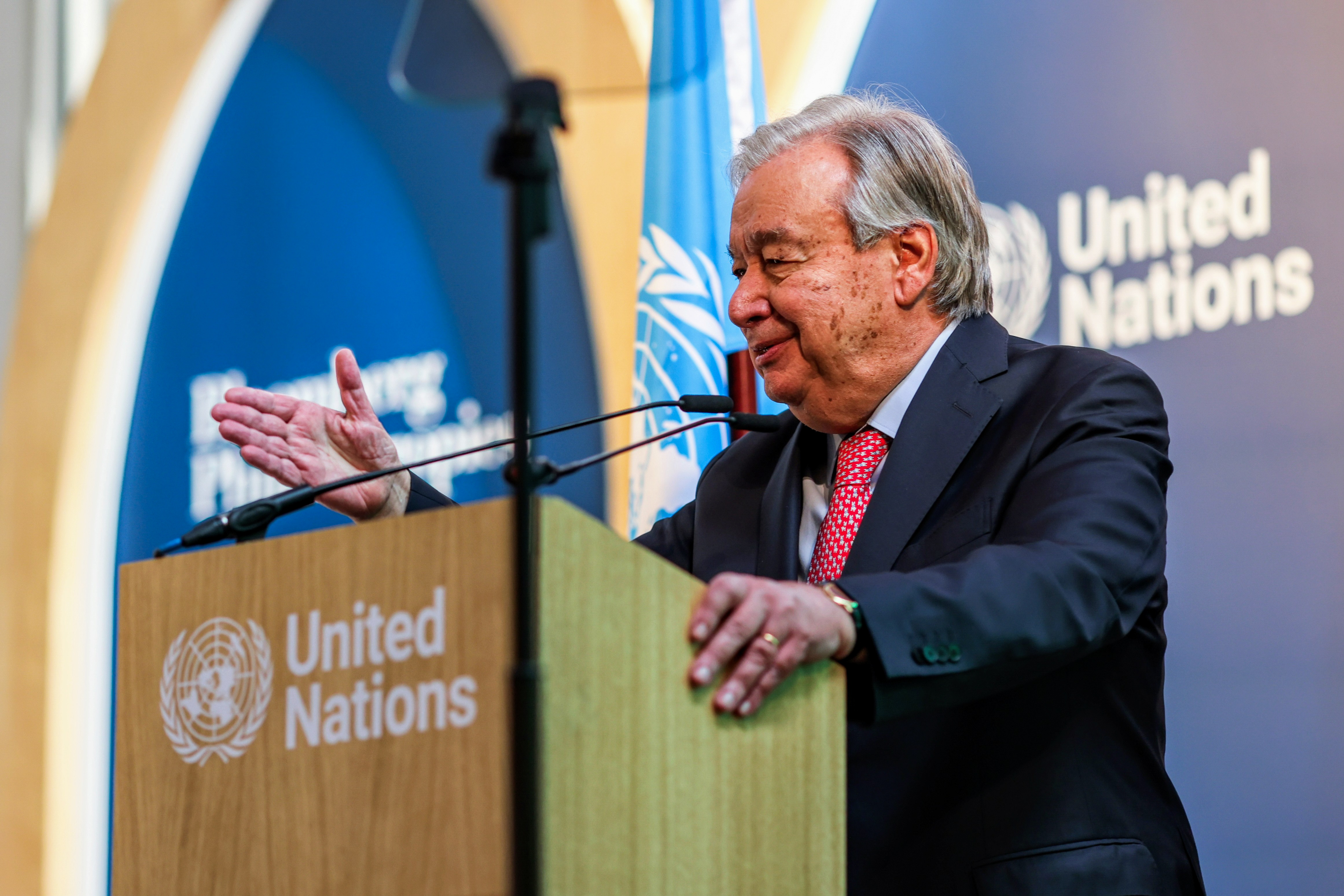
UN Secretary-General António Guterres issued a global call to action on Tuesday (23) during London Climate Action Week, placing methane (CH4) at the center of the climate response.
Methane is a greenhouse gas. Although it remains in the atmosphere for less time than carbon dioxide (CO2), it has an 80-fold greater warming potential. While CO2 defines the long-term climate crisis, methane determines the pace of warming this decade.
“We eliminated ozone-depleting chemicals. Methane pollution must be next,” Guterres said. “I call on producer and consumer governments alike to set a new global standard for the oil and gas sector: near-zero methane emissions across the value chain.”
To accelerate the transition, Guterres proposed nine priority actions by 2030, organized around three key sectors: fossil fuels, agriculture and livestock, and waste.
In fossil fuels — responsible for approximately 38% of global methane emissions — the priority will be to eliminate leaks, end routine flaring and venting, and establish global standards for low-methane-intensity fuels. According to the UN, 75% of these emissions could be avoided by 2030 using already available technologies.
In agriculture and livestock, which account for 42% of emissions, the focus is on increasing productive efficiency, improving livestock management, reducing losses, and redirecting subsidies. In the waste sector, which accounts for 20% of methane emissions, the challenge is to eliminate open dumpsites, expand biogas capture, and build urban circular economy systems.
If adopted together, these measures could reduce global emissions by up to 32% this decade, and the majority of them — around 80% — can be implemented at low cost.
According to Adalberto Maluf, Secretary for Urban Environment, Water Resources and Environmental Quality at Brazil’s Ministry of Environment and Climate Change, who was present at the event in London, “methane reduction is our greatest chance to reduce global warming in the short term: the technologies are already proven and, from a financial standpoint, many of these actions make sense.”
“This is why the issue of methane reduction and other short-lived climate pollutants has gained such importance: to return to the mission of keeping global warming limited to 1.5°C,” Maluf said. Brazil has joined the oil and gas fugitive emissions reduction program to expand national actions and regulations.
Last November, Brazil, China, and the United Kingdom, with support from the COP30 Presidency, co-organized a methane summit bringing together representatives from Barbados, France, Germany, the Climate and Clean Air Coalition, and Bloomberg Philanthropies. The summit launched a set of landmark initiatives to accelerate global action on methane and other non-CO2 greenhouse gases.