
UN Secretary-General and President Lula convene global leaders to discuss COP30
Heads of state and government will participate in a virtual meeting to address climate change and a just transition. The importance of countries delivering updated Nationally Determined Contributions (NDCs) by September will also be emphasized.
By Mayara Souto | mayara.souto@presidencia.gov.br
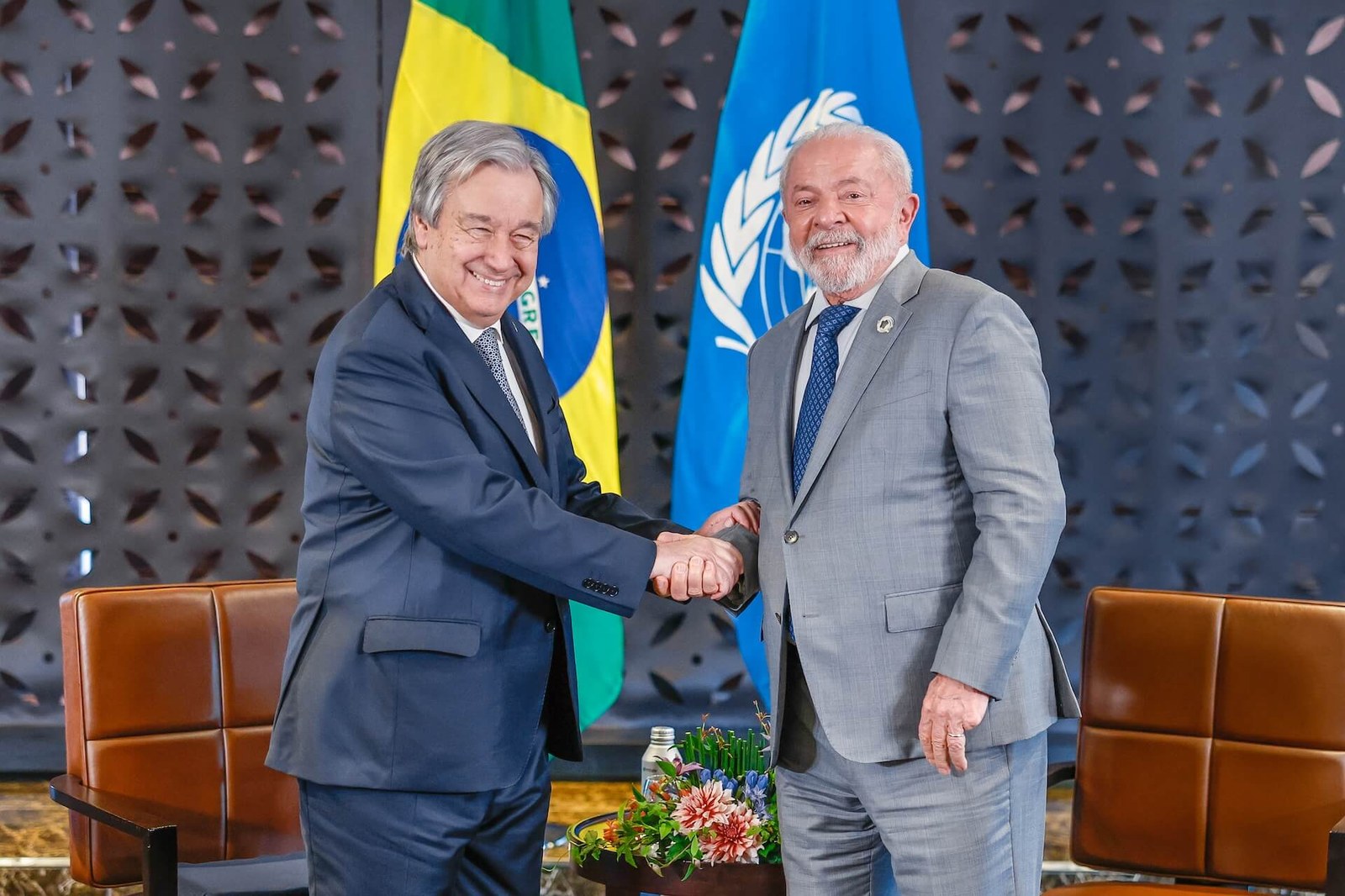
On Wednesday, April 23, United Nations (UN) Secretary-General António Guterres, and Brasil's President Luiz Inácio Lula da Silva will host a virtual meeting of global leaders to address climate change issues. COP30 President, Ambassador André Corrêa do Lago, also attends the meeting.
"Brasil's great effort in the run-up to COP30 is mobilization, because we know its international context is not seen as suitable for discussions and progress on climate change. But we believe that there is a great desire and a strong impulse to talk about climate change. Therefore, I believe that this dialogue will be very important, and it is part of this commitment of [UN] Secretary-General António Guterres and President Lula to jointly work to ensure a dialogue and a broader mobilization of heads of state towards COP30," Corrêa do Lago said at a press conference on Tuesday, April 22.
UN Climate Action Deputy Secretary-General Selwin Hart, Guterres' special advisor, said that the meeting seeks to increase leaders' engagement with the COP30 agenda amid geopolitical pressures.
"The reality is that we need the engagement of leaders at this critical moment. These leaders who have been invited are a small – but significant – gathering of leaders from some of the world's largest economies. They are countries with important regional leadership roles, countries that have held co-chairs since the Paris Agreement, and some of the world's most climate-vulnerable nations. This is a really important year for advancing the climate agenda. It's the 10th anniversary of the Paris Agreement, it's also the year that countries will submit their Nationally Determined Contributions (NDCs)," Hart explained, also during a conversation with journalists.
Only 19 countries from 196 signatories to the United Nations Framework Convention on Climate Change (UNFCCC) have so far submitted their NDCs with updated targets. The initial deadline was in February, but it was extended to September because many submissions were still missing. The NDCs are the targets set by each country to reduce greenhouse gases emissions and limit global warming to 1.5ºC, as determined in the Paris Agreement. The meeting is also expected to raise awareness of the importance of delivering the new NDCs on time.
"On the timeline, September seems to be emerging as a moment when many countries will submit NDCs. Of course, we are pushing others to submit even before that. We must get signals from some of these key economies. The Secretary-General [Guterres] asked parties at COP28 to summon a special high-level event in September on NDCs - he has already signaled that he will do this to support the creation of leverage, thus providing a platform for any announcements, but also to take stock of where we are and build a political dialogue," he says.
Multilateralism
COP30 marks a turning point for dealing with climate change, with a focus on climate mitigation and adaptation. The Brazilian presidency has the challenge of making resolutions that are more assertive and demanding actions that have not yet been implemented.
"It is at times like this, when we have divisions and uncertainties, that we need robust global leadership to move forward with clarity, courage, and collaboration. That's the kind of leadership we saw a decade ago, when the Paris Agreement and the 2030 Agenda were completed, which also gave us the Sustainable Development Goals (SDGs). It's a step towards COP30, set to be a crucial moment to demonstrate to the world that multilateralism works, that international cooperation works, and that the Paris Agreement remains our greatest hope for tackling the climate crisis," reflected the UN Assistant Secretary-General for Climate Action.
Corrêa do Lago also stressed how the conversation with global leaders about COP30 should stress the Brazilian presidency's desire to generate tangible results as an outcome of the Climate Conference.
"We've been saying how important it is to show the world that the consequences of these negotiations are actions, results, examples, and solutions. So it's a different dynamic from before. Nothing against negotiations, but, as you know, they've been going on for many years. But I think that, at this stage, we've negotiated enough to show more action. And I think the public expects this to at least believe in the process. As we want to strengthen multilateralism, we have to show that multilateralism is not just about negotiating documents. It's about the consequences of the documents we negotiate," said the COP30 president.
This Wednesday's talks are the first of the year of this magnitude. According to Hart, other meetings to discuss COP30 and climate commitments should take place between now and the Conference, scheduled for November 10–21 in Belém, Pará.
English Version: Trad. Bárbara Menezes
Proofreading by Enrique Villamil