
President Lula: “Belém will be the place where we renew our commitment to the Paris Agreement.”
At a thematic session marking ten years of the international commitment to limit global warming, the Brazilian president called for urgency in implementing the Paris Agreement. He also drew attention to the need for climate financing for developing countries
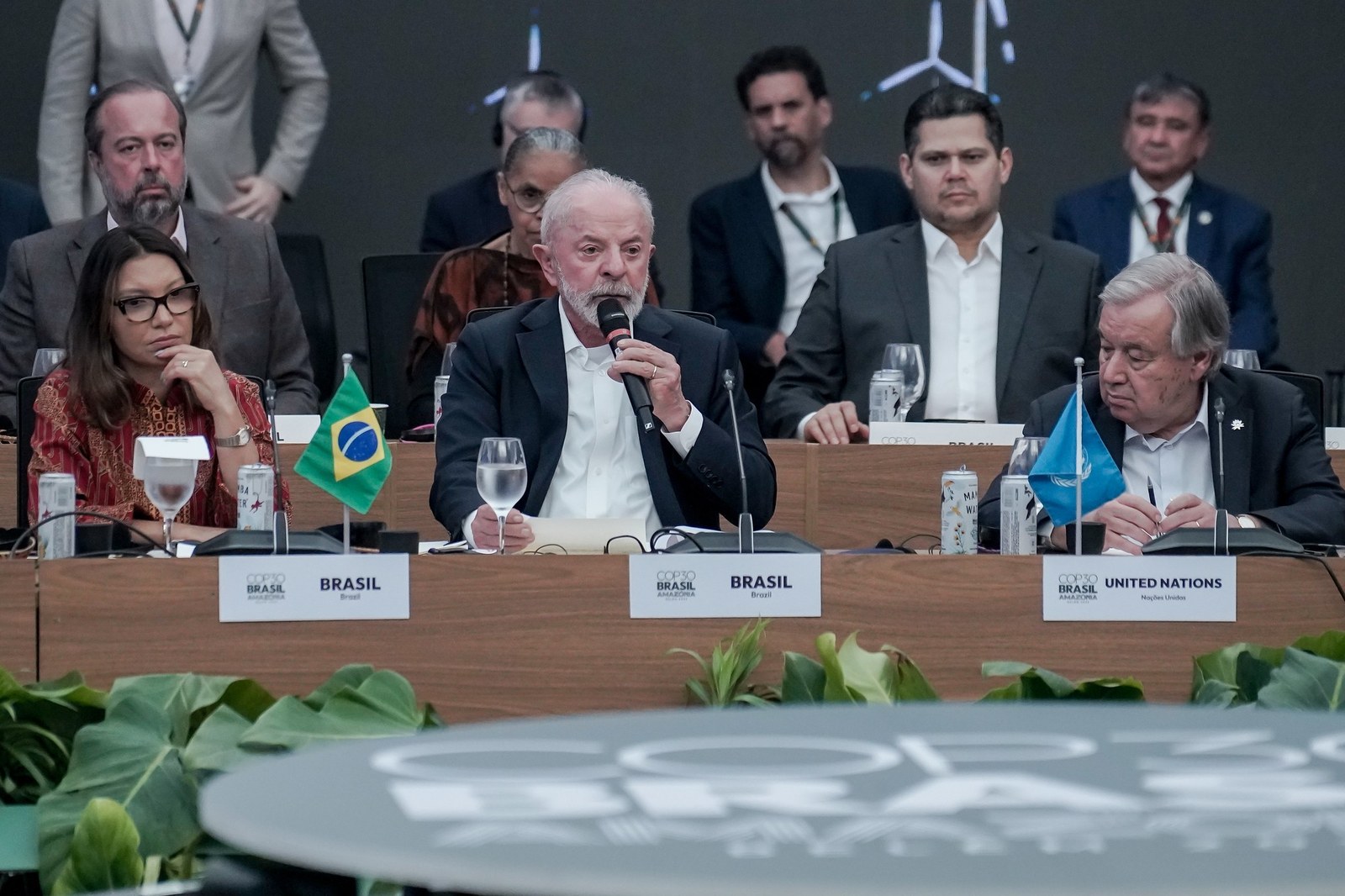
By Mayara Souto / COP30
The final session of the Belém Climate Summit, on Tuesday, November 7, invited leaders to reflect on ten years of the Paris Agreement—, which calls for efforts to limit Earth’s temperature rise to 1.5°C. In his opening speech, the Brazilian President, Luiz Inácio Lula da Silva, reaffirmed the intention to advance the implementation of this international commitment during COP30, as well as the climate financing needed to support it.
“As far as Brazil is concerned, Belém will be the place where we renew our commitment to the Paris Agreement. This means not only implementing what has already been agreed, but also adopting additional measures capable of bridging the gap between rhetoric and reality,” the Brazilian President began.
To that end, Lula emphasized the importance of countries submitting ambitious Nationally Determined Contributions (NDCs) to effectively limit global warming to 1.5°C—especially those nations that have historically emitted the most greenhouse gases.
“We can move toward the future without giving up our right to demand accountability from those who have historically benefited the most from pollution. The regions now at risk of becoming uninhabitable are in Latin America, in Asia, and in Africa. The islands that may disappear are in the Caribbean and in the Pacific. To remain silent is to once again condemn those who are already the wretched of the Earth,” the Brazilian President said with emotion.
The Secretary-General of the United Nations, António Guterres, explained that the NDCs have served as a kind of “thermometer” of countries’ climate ambition. However, they have not been sufficient in this first decade of the Agreement. According to him, achieving the 1.5°C target would require a 60% reduction in global greenhouse gas emissions by 2035.
“The new NDCs deliver only a 10% reduction. We need an acceleration plan to close the gaps in both ambition and implementation of the NDCs. And that acceleration must begin here in Belém,” the UN representative emphasized.
Climate financing
During the session, developing countries reported the challenges they face in implementing measures to combat climate change. Representatives of Small Island Developing States (SIDS), for instance, called for support from the largest economies, as they have been severely affected by extreme climate events.
Lula then advocated for the completion of the Baku to Belém Roadmap to mobilize USD 1.3 trillion per year in climate financing for developing countries by 2035. The presidencies of COP29, from Azerbaijan, and COP30, from Brazil, presented the plan to achieve this investment last Wednesday, November 5.
“Without adequate means of implementation, it is unfair and unrealistic to demand ambition from developing countries. The Baku to Belém Roadmap shows that, with political will, we have alternatives to reach the target of USD 1.3 trillion per year,” emphasized the Brazilian President, reaffirming that only a small share of climate financing reaches the Global South.
In light of this scenario, Secretary-General António Guterres said that the Roadmap’s mission is to “restore trust that climate finance will flow in a predictable, fair, and scaled-up manner.”
“We must develop innovative forms of financing, including debt-for-climate swaps, risk-sharing mechanisms, and bold instruments such as the Tropical Forest Forever Fund, without forgetting the contribution of carbon markets. We must also continue to push for reforms in the global financial architecture so that it reflects today’s world and serves the needs of developing countries,” he stated.
In closing, Lula and Guterres issued a call for climate action to all countries and urged a renewed commitment to what has already been pledged. “At COP30, we will renew the great promise the world made a decade ago in Paris, ushering in a new decade of implementation and acceleration,” said the Secretary-General.
“Instead of abandoning hope, we can build together a new era of prosperity and equality,” concluded the Brazilian President.