
Governors of Southern and Southeastern Brasil Reaffirm Commitment to Climate Action at Pre-COP Meeting
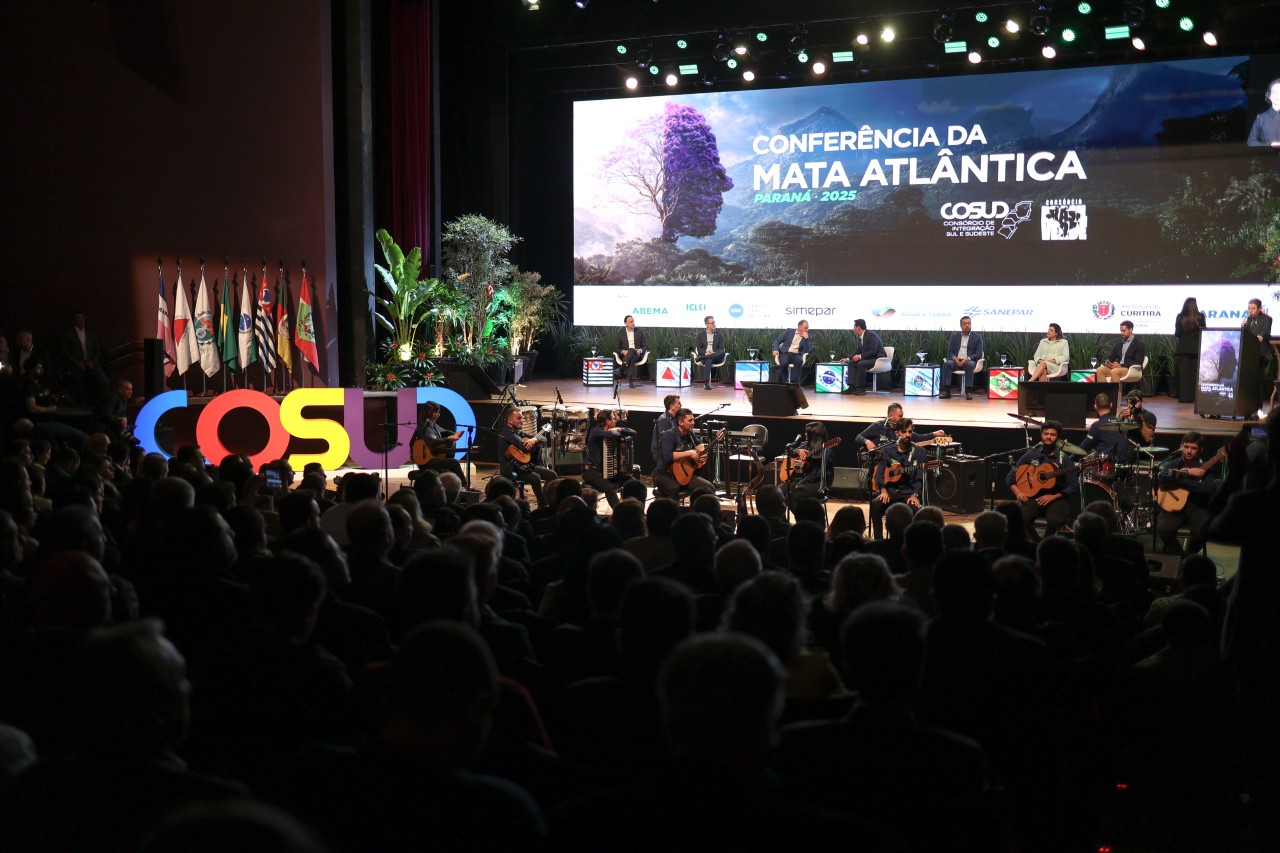
Representatives sign joint declaration during Atlantic Forest Conference held this week in Curitiba
By COP30 Presidency
Governors from Southern and Southeastern Brasil reaffirmed their commitment to climate action in a joint declaration signed at the Atlantic Forest Conference, a preparatory event for COP30 that concluded on Thursday, August 21, in Curitiba (Paraná). The document underscores the leadership role of subnational governments in implementation efforts and stresses the need for their engagement in the design and execution of national climate policies.
“The climate emergency is a global reality that affects all of us and is the shared responsibility of all three levels of government: municipalities, states, and the federal government. Political polarization must not prevail. Dogmas do not contribute to meaningful debate. What is needed is unity and cooperation to combat climate change,” the declaration states.
The declaration was signed by Governors Cláudio Castro (Rio de Janeiro), Eduardo Leite (Rio Grande do Sul), Ratinho Junior (Paraná), Renato Casagrande (Espírito Santo), and Romeu Zema (Minas Gerais), along with Vice-Governors Felicio Ramuth (São Paulo) and Marilisa Boehm (Santa Catarina).
Although COPs have historically been forums for negotiations between nations, the governors emphasized that subnational actors are central to the implementation of international agreements. They noted that coordinated action across levels of government can accelerate the ecological transformation of Brasil and strengthen climate governance.
The Atlantic Forest Conference is part of the “COP of the Biomes,” a series of preparatory events leading up to the United Nations Climate Change Conference. The Paraná meeting coincided with the 13th session of the South-Southeast Integration Consortium (Cosud).
COP30 CEO Ana Toni attended the opening session and remarked that state-level mobilization demonstrates how the COP30 process is already producing results:
“COP is not limited to two weeks of negotiations. It is also this broader process of recognizing Brasil’s calling as a nation of extraordinary sociobiodiversity, with all of its biomes,” Toni said. “It is a unique opportunity for Brasil to position itself as a provider of climate solutions.”
Atlantic Forest
In the “Curitiba Declaration,” governors reaffirmed their commitment to protecting the Atlantic Forest and stressed the urgency of accelerating the biome’s adaptation to climate change. They highlighted joint initiatives aimed at reconciling economic development with environmental sustainability, including the Atlantic Forest Treaty, signed in October 2023. The treaty calls for the planting of 100 million native trees and the restoration of 90,000 hectares by 2026.
Recognized as a national heritage site and home to vast biodiversity, the Atlantic Forest has lost roughly 70 percent of its original vegetation to deforestation driven by economic cycles throughout Brasil’s history. According to data from the Prodes satellite monitoring system of the National Institute for Space Research (Inpe), the biome’s deforestation rate between August 2022 and July 2023 (765 km²) was the lowest since records began in 2001. President Luiz Inácio Lula da Silva has pledged to achieve zero deforestation across all biomes by 2030.
COP Of The Biomes
Responding to the call of the COP30 Presidency, state consortia across Brasil have embraced the proposal to strengthen subnational leadership in confronting the climate crisis, initiating a series of regional climate conferences organized by biome. The Atlantic Forest Conference marked the start of this process. Upcoming conferences are already scheduled for the Pantanal and the Caatinga in September.
The cycle of events is expected to produce a joint political commitment from state governments and the launch of a “Subnational Solutions Bank.” The initiative seeks to consolidate and disseminate successful policies and programs already underway in the states, creating a reference framework for effective and replicable climate policies within Brasil and, eventually, on the global stage.