
Brazilian Socio-Environmental Fund Invested over 470 million Reais in 228 Projects over 16 Years
Nearly 57 million people have already benefited from FSA CAIXA, managed by the bank. The mechanism, which will be presented at COP30, has ensured the planting of over 3.9 million trees and the preservation of 721 springs.
By Caixa Econômica Federal
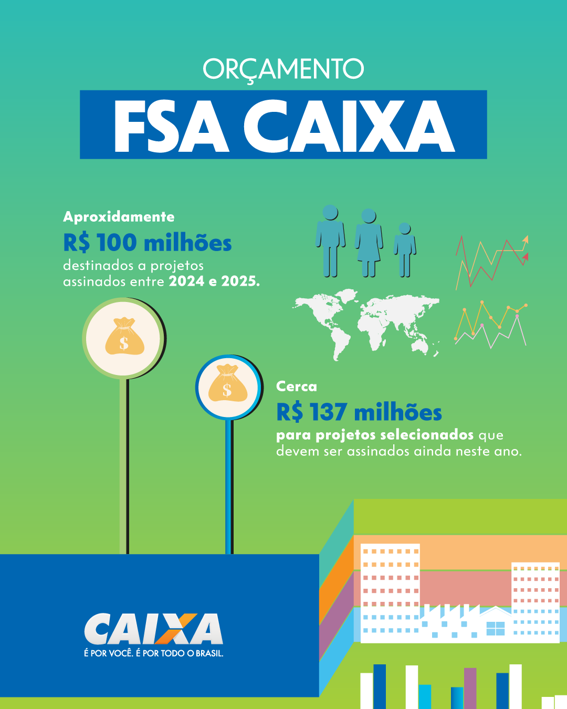
Created in 2010, the CAIXA Socio-Environmental Fund (FSA) has allocated around R$474 million to 228 projects across various areas of activity by 2025. It is estimated that nearly 57 million people have benefited directly and indirectly from this financial mechanism. The results achieved so far will be presented by the Brazilian bank at COP30.
The FSA works to preserve natural resources, restore springs and degraded areas, support land regularization, and promote the expansion of water sources and treatment stations. It also contributes to tackling the root causes of social, cultural, and educational inequalities by supporting health, sports, protection, and income-generating initiatives for vulnerable populations—especially children, women, and youth.
FSA resources come from CAIXA’s adjusted annual net profit. Access to these funds is granted through public selection of submitted proposals.
Jean Benevides, acting Vice President of Sustainability and Digital Citizenship at CAIXA, highlights some of the fund’s achievements and future investment prospects: “We are talking about 476,000 families with food on the table, professional training, income generation, and support for preserving their communities. These are children, women, quilombolas, Indigenous peoples, and Brazilians from all regions. The initiatives also include the planting of over 7 million trees. FSA CAIXA has supported 120 industries and 88 businesses in the ceramics sector. All of this aligns with the UN Sustainable Development Goals and the goals of COP30,” he emphasized.
The fund began operations with eight selected projects in 2011. By 2012, that number had multiplied tenfold, marking the beginning of a successful initiative.
Climate Financing
Environmental advocate Thiago Ávila emphasizes that through the FSA, CAIXA contributes to building a healthy society in harmony with nature, while also supporting Brazil’s vocation to become a global socio-environmental powerhouse.
“In this context, CAIXA’s role is to drive initiatives that help halt global environmental degradation and regenerate our biomes and ecosystems. The fund plays a strategic role in this mission, as it is the main instrument connecting the bank to projects ranging from grassroots community efforts to large-scale initiatives across the country,” he explains.
Reforestation and Prosperity
One of the projects transformed the life of Francisca Sarijane, 32. A mother of two boys—one aged 15 and the other 5—Francisca lives in Santana do Araguaia, in the far south of Pará. She discovered the Araguaia Biodiversity Corridor Ecological Restoration project three years ago while searching for a job to supplement her family’s income, which had previously depended entirely on her husband.
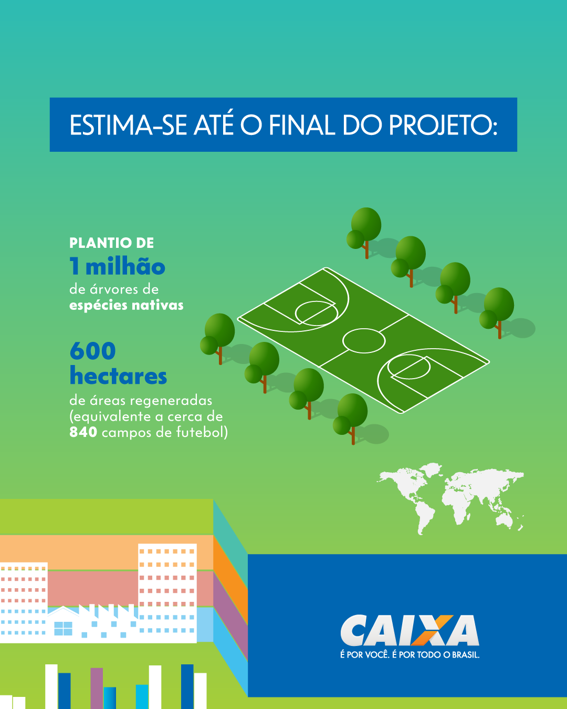
Carried out by the Black Jaguar Institute, the project operates in the municipalities of Caseara (TO) and Santana do Araguaia (PA), both part of the Araguaia Biodiversity Corridor. It focuses on planting native tree species from the Cerrado and Amazon biomes, aiming to restore the balance between nature and humanity and preserve the environment for future generations.
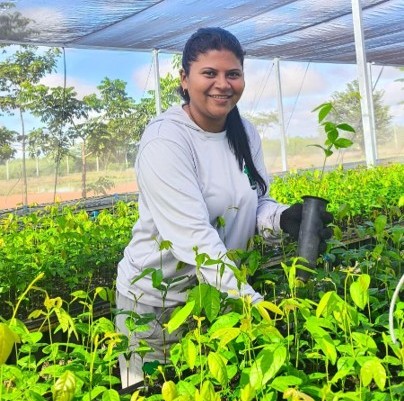
Francisca works producing seedlings and ensuring they remain healthy until they reach the field. She explains how her life changed after becoming a nursery worker: “It was not just the financial part—being able to help my family that was going through hard times—but also my outlook on the future from now on. Before I got to know the project, I lived in my little bubble. I had no idea what was happening out there, what could happen to the planet, or what could harm us.”
Now, she makes a point of sharing the knowledge she gains from the project. “What I learn here, I pass on to my children, and so on. This generation can make a difference—we cannot wait any longer, the future is now. Today we are facing climate change, lots of wildfires,” she says. “We have to care for and preserve the environment so the next generation does not suffer what we are suffering because of the previous one.”
In addition to her children—who, inspired by their mother’s work, already share what they have learned at school—Francisca also has meaningful exchanges with students from schools and universities who visit her workplace. “We get them involved in the work, show them what we do day to day—planting, sowing, caring, watering—they really get their hands dirty. You can see the sparkle in their eyes, and that is moving. Teaching them and knowing they will pass it on is truly rewarding,” she says proudly.
Degraded Land Transformed into Agroforestry
In southern Ceará, in the rural area of the municipality of Nova Olinda, Francisco Luciano, 41, lives with his wife and children. He is one of the beneficiaries of another project funded by FSA CAIXA: the Chapada do Araripe Conservation and Restoration Network, carried out by the Northeast Environmental Research Center (CEPAN). His family received funding to implement an Agroforestry System (SAF) on their land. “CEPAN saw that we were already preserving and planting, and they said: ‘Luciano, you deserve to be included in the SAF. We will take care of everything. You will not have to spend a thing.’ And I was thrilled. It was my dream to set up an agroforestry system, but I could not afford it,” he shares, emotionally.
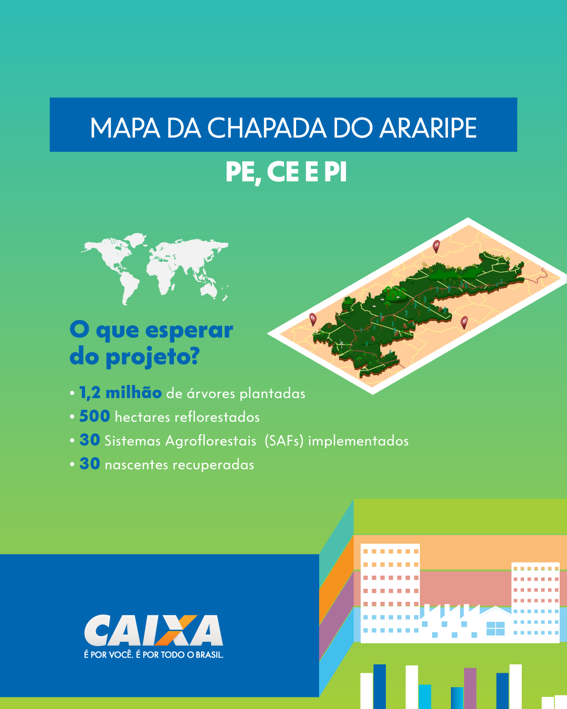
The project promotes the conservation of Caatinga biodiversity, generating social and economic benefits through the reforestation of 500 hectares, implementation of agroforestry systems, capacity building, and the development of local markets for seeds and seedlings of native species. It also encourages the engagement and empowerment of women and traditional communities in the Chapada do Araripe region, located in the states of Ceará, Pernambuco, and Piauí.
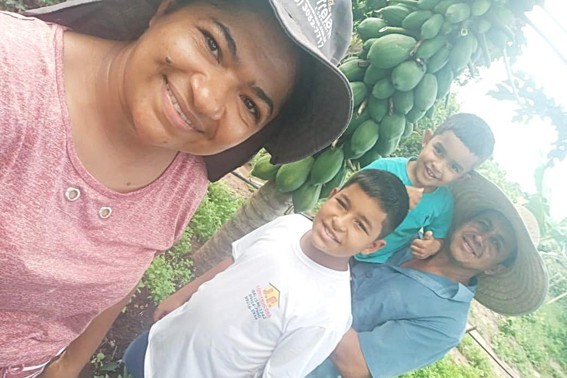
Luciano says that his family has always relied on agriculture for their livelihood. Eight years ago, after spending some time living in the Central-West region of Brazil, he returned to his home state, sold some belongings, and three years ago bought the property where he built not only his house but also a peaceful haven with fresh air for his family. “My land was very degraded because I bought it from people who raised cattle. I started preserving it, and today it looks very different from what it was. I believe that through this reforestation, it will improve 100%.”
He envisions that, in the future, he will be able to earn income from the seeds of the trees he recently planted and, with the help of the project, deliver them to nurseries.
Through the project supported by FSA CAIXA, the farmer has been improving his knowledge of farming and learning pruning techniques, how to produce biomass, and how to eliminate invasive weeds before starting a new crop. Luciano grows cassava, beans, and fruit crops such as lime, papaya, mango, and passion fruit. “We sell, consume, and give to those who ask. So you feed yourself, earn a little money, and help others,” he says happily.
Translation: Michel Emmanuel Félix François (POET/UFC)
Proofreading: Tadeu Azevedo (POET/UFC)