
Amazon Fund Quadruples Approvals and Expands Reach in Climate Finance Push
Brazil’s National Bank for Economic and Social Development says it has rebuilt the mechanism’s operational capacity after a four-year halt, reaching record levels of activity
By BNDES
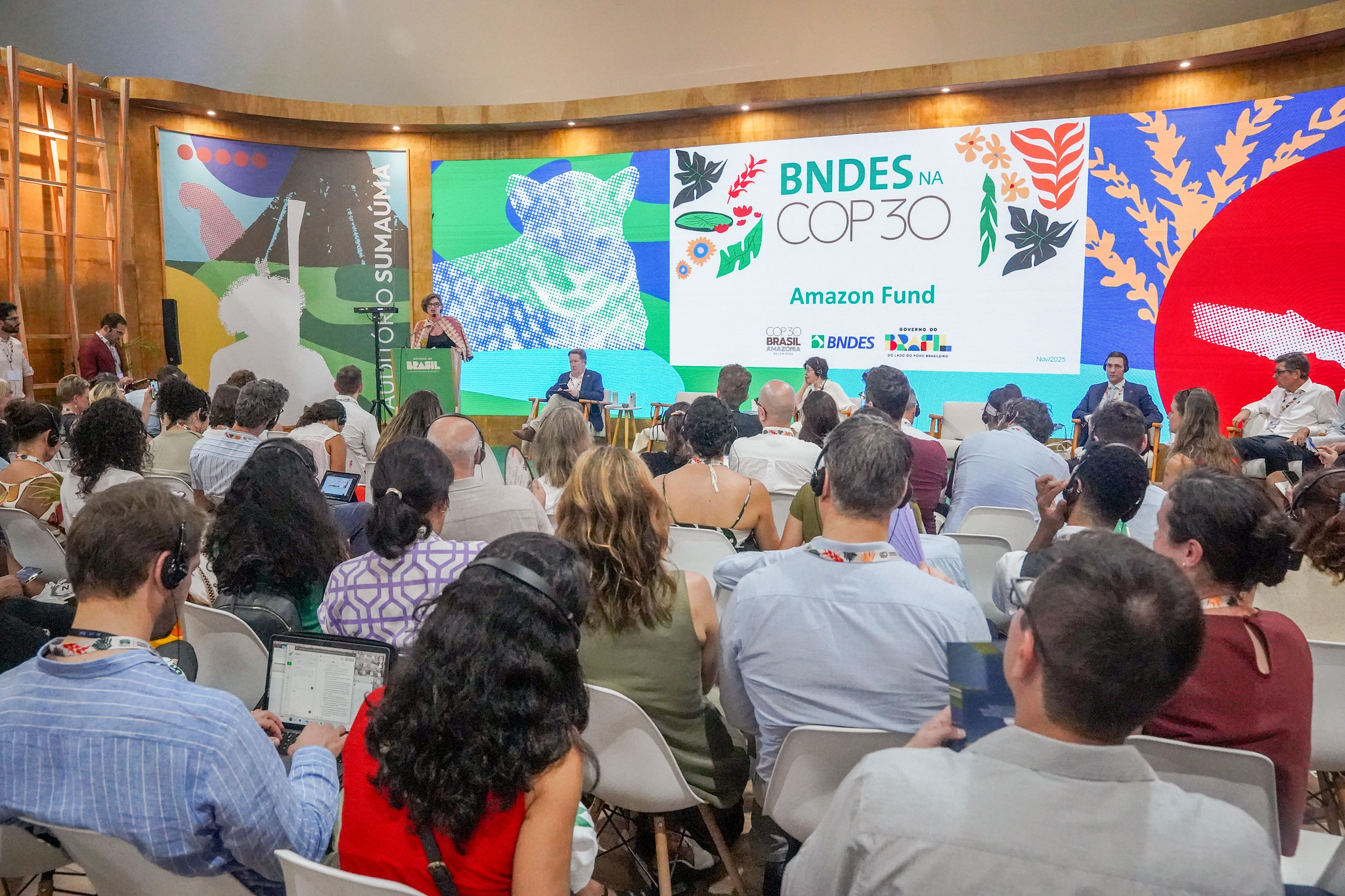
At a COP30 session in Belém, Brazil’s National Bank for Economic and Social Development (BNDES) and the Ministry of the Environment and Climate Change (MMA) released their most extensive review yet of the Amazon Fund, highlighting its growing scale, reach, and impact. Over the past 17 years, the Fund has financed more than 140 projects, covering 75 percent of municipalities in the Legal Amazon, supporting more than 260,000 people, and establishing itself as an international benchmark for governance, transparency, and measurable results in forest restoration, territorial protection, the sociobioeconomy, land regularization, environmental public security, education, and the institutional strengthening of traditional peoples and communities.
The assessment, presented by Tereza Campello, BNDES’s Director of Social and Environmental Affairs, shows that after four years without approving a single project (2019–2022), the Amazon Fund rebuilt its operational capacity and moved into its most productive period to date, quadrupling its annual average of project approvals.
“After four years without approving a single project, we have rebuilt the entire portfolio, reorganized the strategy, and demonstrated that it is possible to work with scale, urgency, and impact. This assessment shows the strength of an instrument that combines public policy, science, social participation, and international cooperation,” Campello said.
João Paulo Capobianco, Executive Secretary at the Ministry of the Environment and Climate Change, noted that these results reflect the consolidation of a long-term State strategy. He recalled that the Amazon Fund was conceived as part of Brazil’s effort to combat deforestation beginning in 2006, through the Action Plan for the Prevention and Control of Deforestation in the Amazon (PPCDAm), which brought together 13 ministries. “We lowered emissions by 5 billion tons of CO₂ equivalent from 2004 to 2012 by tackling deforestation directly. We demonstrated to the world that the effort was grounded in method, in science, and in public policy.”
Capobianco also highlighted the initiative’s ethical and intergenerational dimension. “Every investment made by the Amazon Fund carries a powerful message: forests have value if they are standing. Moving toward sustainable development is not utopian — it is a political decision.”
The Fund’s relaunch coincided with an unprecedented expansion of its donor base. The number of contributors grew from three to ten, with new support from the European Union, Switzerland, the United States, the United Kingdom, Denmark, Ireland, and Japan. They join the Fund’s historic donors, Norway and Germany, which strengthened their commitments, alongside a contribution from Petrobras. Norway’s Minister of the Environment, Andreas Bjelland Eriksen, the Fund’s largest donor since 2008, underscored the partnership’s strategic role and expressed confidence in this new phase during an event at COP30.
Representing Germany, Wolfgang Bindseil, Minister at the German Embassy in Brazil, reiterated his country’s commitment to the Fund. “Germany has backed the Amazon Fund from the very beginning and continued to do so even in the most difficult periods. Its swift and steady recovery highlights both its importance and its international credibility. The expansion in the number of projects, the growing territorial reach, and the institutional strengthening of agencies like the Brazilian Institute of the Environment and Renewable Natural Resources (Ibama) make clear that this is a global model for results-based climate finance,” he said.
Learn more
Translation: Tadeu Azevedo (POET/UFC)
Proofreading: Michel Emmanuel Félix François (POET/UFC)