
COP30 Unveils Priorities to Advance the Baku to Belém Roadmap to 1.3 T
The COP30 Presidency is advancing the next phase into concrete implementation, supported by the Circle of Finance Ministers, the Council on Economics, Finance and Climate, and partners including IHLEG, CPI, WRI, and others
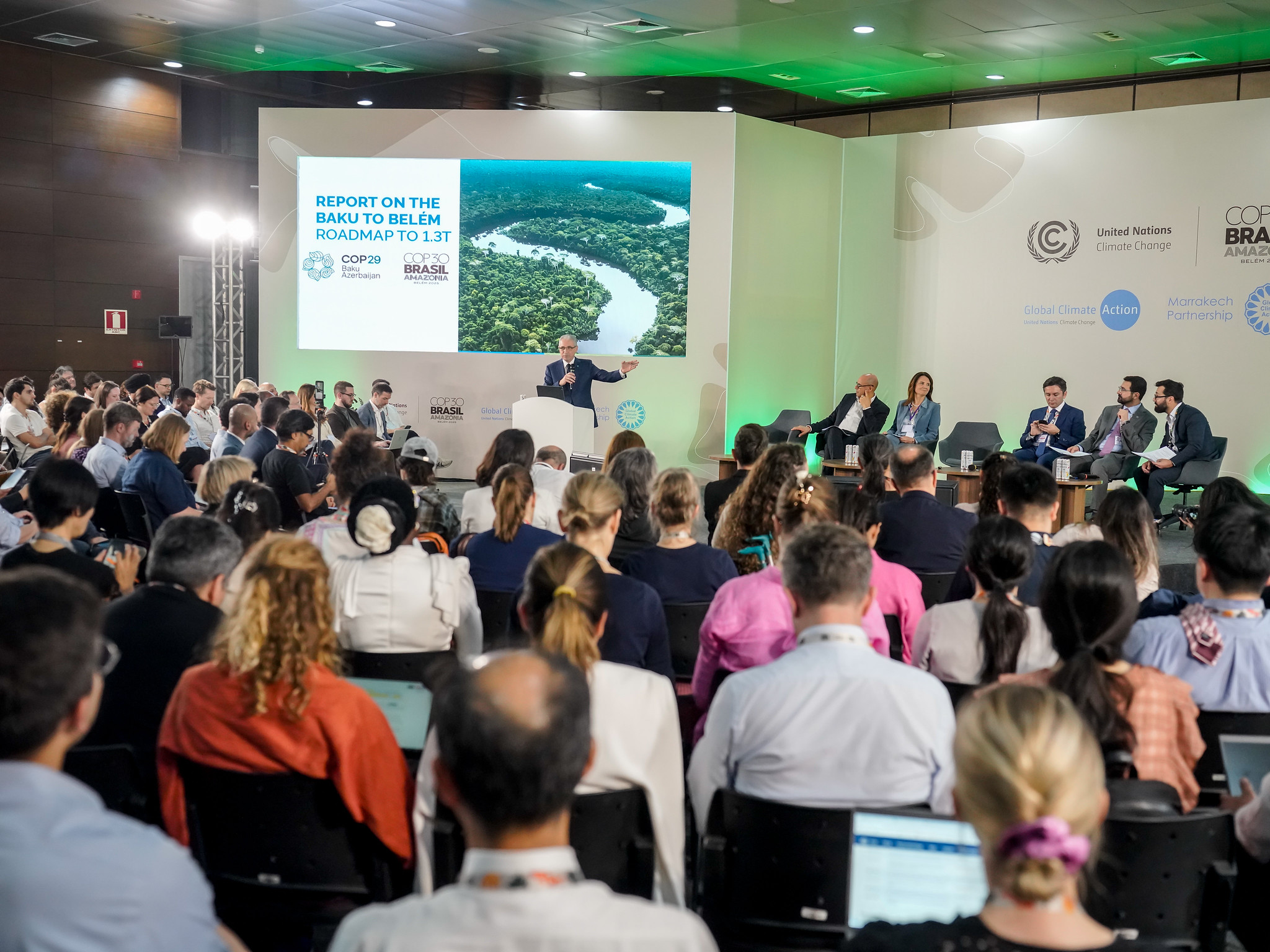
The Baku to Belém Roadmap to $1.3T was presented in November 2025 by the COP29 and COP30 Presidencies, fulfilling the mandate agreed by Parties to the Paris Agreement. At COP30, Parties decided “to urgently advance actions to enable the scaling up of financing for developing country Parties for climate action from all public and private sources to at least USD 1.3 trillion per year by 2035” (Global Mutirão Decision: uniting humanity in a global mobilization against climate change, paragraph 48). The publication of the BB1.3T Roadmap marked a milestone in the collective effort to reach this goal and now serves as a central reference for the next stage of delivery.
As the implementation of the BB1.3T Roadmap begins, and drawing on inputs from governments, financial institutions, experts, and civil society, the COP30 Presidency is structuring its 2026 work around four mutually reinforcing pillars: (I) advancing action and monitoring progress; (II) strengthening analytical foundations for projected sources of finance; (III) linking climate finance to national priorities; and (IV) sustaining broad engagement to mobilize action toward the $1.3T goal.
I. Walking the Road: Agenda for Action and Monitoring
A central priority is to support the further development and consolidation of existing efforts to advance action, alongside tracking progress on the priorities identified in the BB1.3T Roadmap.
Through the continuation of the COP30 Circle of Finance Ministers, and in close collaboration with the Independent High-Level Expert Group on Climate Finance (IHLEG) and the Climate Policy Initiative (CPI), the COP30 Presidency is supporting the development of a framework and monitoring tool to assess global progress on climate finance mobilization toward $1.3T.
Based on the “5Rs” of the Roadmap – Replenishing, Rebalancing, Rechanneling, Revamping and Reshaping – and the underlying action agenda, the framework will provide a structured approach to monitoring how key actors, including governments, multilateral institutions and the private sector, are advancing actions that together can deliver of the $1.3T goal. The framework will also help identify policy and institutional enablers, emerging good practices, and remaining gaps and barriers that need to be addressed to accelerate the scale-up of climate finance.
Strengthening the availability and quality of climate finance data is also essential to support effective implementation and accountability. To this end, the COP30 Presidency is supporting ongoing efforts to map the climate finance data landscape and identify practical steps to improve the availability, quality, comparability, and interoperability of information used to track progress toward the $1.3 trillion goal.
II. A Quantum Leap to $1.3T: Strengthening Analytical Foundations of Projected Sources of Finance
Delivering on the Belém decision to urgently advance action to scale up finance toward $1.3 trillion requires a clearer understanding of how different sources of finance can collectively reach the goal over time.
To strengthen the analytical basis for this effort, the COP30 Presidency is engaging experts to deepen the understanding of key sources of climate finance identified in the Roadmap. This work will help clarify the policy interventions and future pathways — including indicative quantitative trajectories — needed to scale finance across public and private sources, building on existing analysis by experts and institutions.
III. Linking Climate Finance to National Priorities
Nationally Determined Contributions (NDCs) and National Adaptation Plans (NAPs) are the primary vehicles through which countries communicate their efforts and priorities in the global response to climate change. As the climate regime evolves into a new phase focused on implementation, stronger and more coordinated collaboration among governments, financial institutions, regulators, the private sector, and civil society will be essential.
Through analytical work, and building on the thematic action fronts of the BB1.3T Roadmap, the COP30 Presidency is helping to advance an implementation-oriented analysis of sectors, policies, and strategies, with a view to identifying feasible capital structures that respond to specific NDC and NAP objectives and reflect diverse financing contexts in developing countries. This effort is intended to equip countries with practical tools to mobilize and link finance to national priorities and realities, while fully respecting country ownership and supporting a diversity of nationally determined pathways.
IV. Sustaining Engagement and Mobilization
The extensive engagement process that generated more than 220 submissions informing the preparation of the Baku to Belém Roadmap to 1.3T marked an important starting point. The implementation phase must build on this momentum to widen the debate, helping translate the Roadmap’s priorities into action.
The Presidency will continue to support this process through a series of engagements across key moments in the climate and finance calendars. These include the UNFCCC Regional Climate Weeks, the 64th session of the UNFCCC Subsidiary Bodies (SB64), and the Spring and Annual Meetings of the International Monetary Fund and the World Bank, as well as other major climate and finance convenings throughout the year.
Together, these four pillars will help translate the Roadmap’s priorities into practical steps that accelerate the delivery of climate finance for developing countries on the ground, while also informing COP31 with a first implementation update on progress toward the $1.3 trillion goal.
The COP30 Presidency will take this work forward in close collaboration and dialogue with Parties, the COP29 Presidency, incoming COP Presidencies, the UNFCCC secretariat and the Standing Committee on Finance, the Climate Champions Team, and a wide range of civil society organizations and research institutions, as well as relevant international fora and coalitions, ensuring a sense of continuation.