
COP30 Presidency Advances Global Coordination to Implement National Adaptation Plans
NAP Implementation Alliance receives strong support at NAP Expo 2026, as discussions reinforce the need to elevate NAPs to the same political standing achieved by NDCs
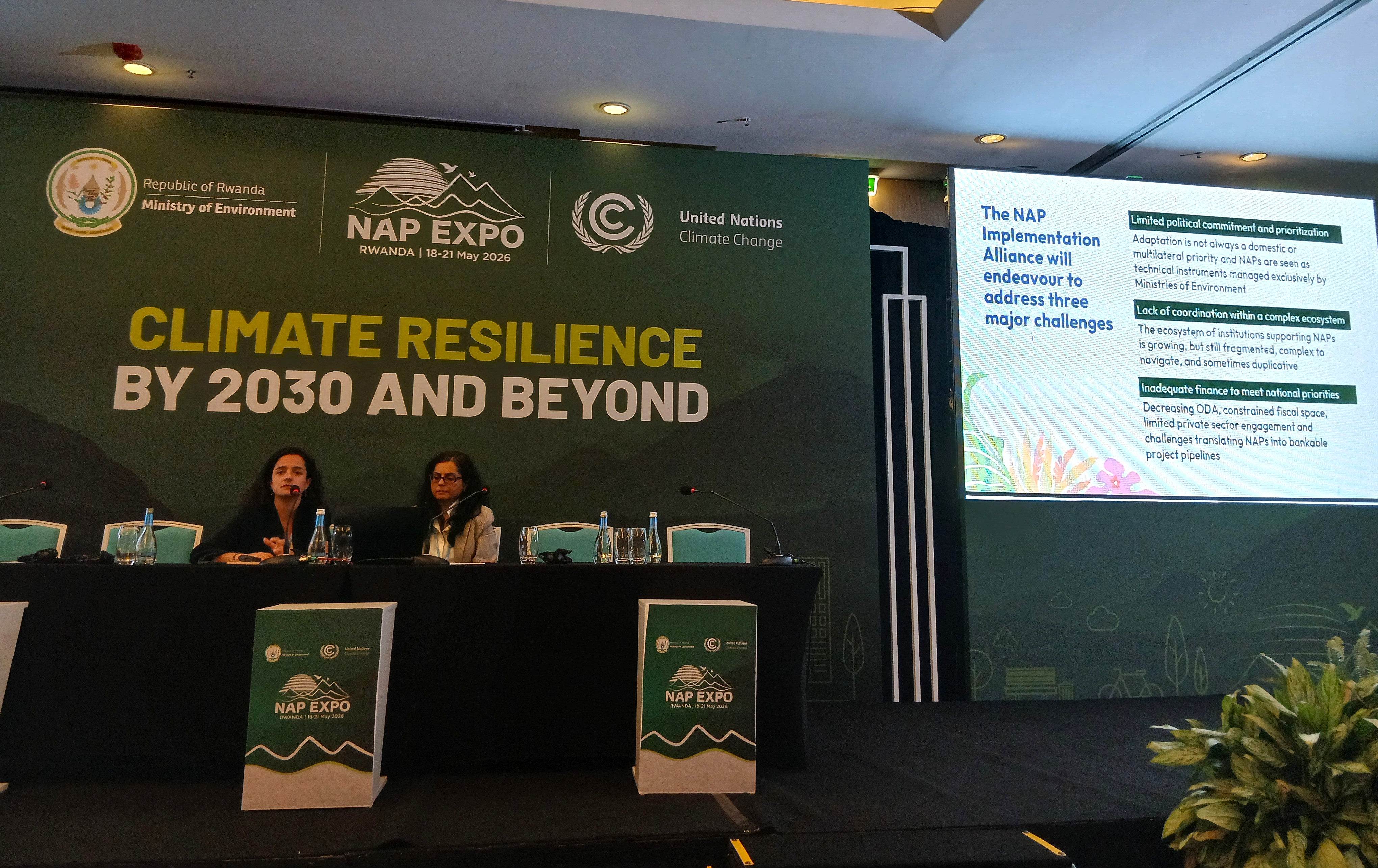
During NAP Expo 2026, held from May 18 to 21 in Kigali, the COP30 Presidency presented the first advances in the structuring of the NAP Implementation Alliance. Developed in partnership with the United Nations Development Programme (UNDP), the governments of Italy and Germany, and contributors including the NAP Global Network and the NDC Partnership, the initiative aims to elevate the political profile of National Adaptation Plans (NAPs) and accelerate climate adaptation implementation across developing countries.
The presentation was led by Teresa Rossi, Adaptation Coordinator for the COP30 Presidency, and Rohini Kohli, Senior Adaptation Policy Advisor at UNDP. According to the speakers, the Alliance aims to consolidate NAPs as the main instrument for translating climate commitments into concrete resilience actions.
“NAPs are now the main instrument not only for planning, but for enabling the effective implementation of climate adaptation at the national level,” said Teresa Rossi. According to her, although the plans have formally existed since 2010 under the United Nations Framework Convention on Climate Change (UNFCCC), they have yet to achieve the same level of political priority and financial mobilization as Nationally Determined Contributions (NDCs).
The adaptation agenda still faces significant challenges in mobilizing financing and high-level political engagement. According to Rossi, NAPs are frequently treated as “technical” instruments, concentrated mainly within environment ministries, without sufficient integration with strategic areas such as finance and planning.
The initiative was presented as a political and technical coordination platform capable of bringing together governments, financial institutions, multilateral organizations, the private sector, academia, and civil society organizations. Its objective is to improve coordination across the global adaptation ecosystem, which is currently broad but fragmented.
During the presentation, the COP30 Presidency highlighted that recent decisions adopted at climate conferences reinforce the need to strengthen the adaptation agenda. Key milestones mentioned included the UAE Framework for Global Climate Resilience adopted at COP28, the Baku Adaptation Roadmap discussed at COP29, and decisions adopted in Belém during COP30, including the commitment to triple adaptation finance and the adoption of new global adaptation indicators.
The Alliance also aims to expand access to climate finance. According to Rohini Kohli, the proposal is not to create a new international financial mechanism, but rather to strengthen coordination among existing initiatives and bring countries and financiers closer together. Priorities include supporting the development of bankable project pipelines, promoting matchmaking between governments and investors, and expanding dialogue with multilateral development banks and private financial institutions.
The discussion following the presentation brought together representatives of African governments, experts, and international organizations. Delegates from Tanzania highlighted the importance of the initiative in connecting national priorities with financing flows and integrating adaptation into long-term development planning. Tanzanian representative Fred Manika noted that the country’s NAP process has been incorporated into Tanzania Vision 2050, including climate resilience targets as one of the country’s strategic pillars.
Participants also called for greater involvement of ministries of agriculture, infrastructure, and finance in NAP implementation processes, as well as stronger engagement from universities and research centers within the adaptation ecosystem. Another recurring issue was the need to expand resources available for implementation, especially in light of declining official development assistance and the difficulties many countries face in accessing international climate funds.
One of the main points of consensus during the meeting was the recognition of the Alliance as a strategic mechanism to strengthen coordination among the different actors involved in the NAP implementation ecosystem — including technical assistance organizations, multilateral development banks, financing agencies, implementation partners, and governments. The proposal to bring greater cohesion, alignment, and coordination to the ecosystem was considered particularly relevant given the fragmentation of currently available support mechanisms.
From a political perspective, the initiative reinforces adaptation as a continuous agenda of collective implementation across successive COP Presidencies. The next steps include structuring the governance of the NAP Implementation Alliance. The objective is to consolidate NAP implementation as a shared priority among future COP Presidencies, transforming the Alliance into an anchor initiative for global climate adaptation action.
Among the upcoming milestones is a public Alliance event during the June sessions of the UNFCCC subsidiary bodies in Bonn, Germany — an opportunity to bring together different COP Presidencies and strengthen political engagement around the initiative — followed by meetings during London Climate Action Week, considered a strategic space to deepen dialogue with climate finance actors and accelerate the mobilization of capital for adaptation.
At NAP Expo 2026, an open and self-managed LinkedIn group was also launched to continue fostering collaboration, coordination, and knowledge exchange among actors working on National Adaptation Plan implementation. The group is public and welcomes professionals, institutions, and partners involved in climate adaptation planning and implementation across different regions of the world: https://www.linkedin.com/groups/19432003/