
Bonn Discussions Reinforce Global Convergence Around COP30 Presidency Roadmap to Halt Deforestation and Forest Degradation
Halting and reversing deforestation by 2030 is one of the defining implementation challenges of the Paris Agreement, sitting at the intersection of climate action, economic resilience, biodiversity conservation, and sustainable development.
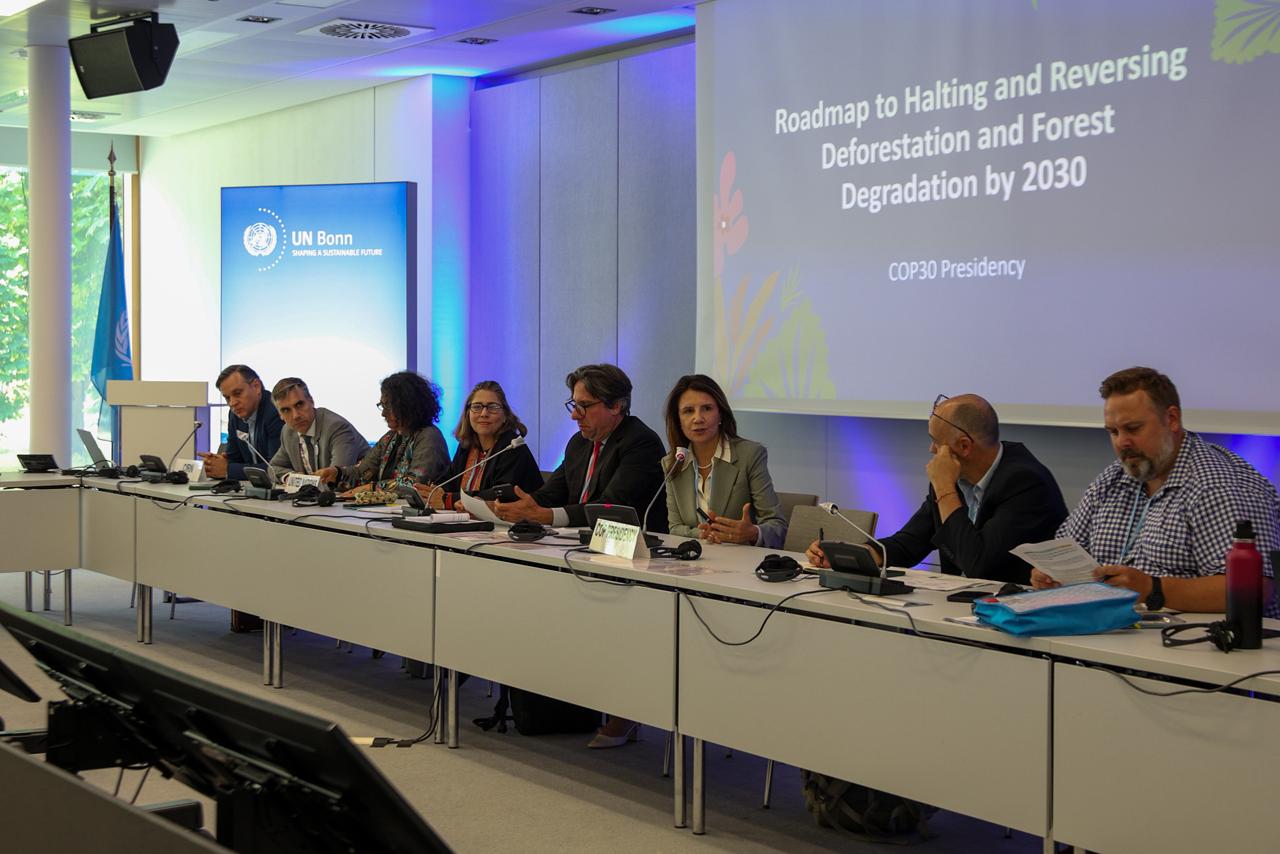
This week at the 64th Sessions of the UNFCCC Subsidiary Bodies (SB64) in Bonn, the COP30 Presidency convened Parties, international organizations, Indigenous Peoples, civil society, and the private sector to discuss the emerging COP30 Presidency Roadmap on Halting and Reversing Deforestation and Forest Degradation by 2030, developed as an action-oriented contribution to implementing paragraphs 33 and 34 of the first Global Stocktake.
The event presented the COP30 proposal for the Roadmap, outlining its structure and highlighting emerging areas of convergence identified through the consultation process. It provided a valuable opportunity to test ideas, gather suggestions and inputs from Parties and civil society, and refine priorities ahead of the Roadmap’s launch. A clear message echoed throughout the discussion: the question is no longer whether forests matter, but how to accelerate implementation at the scale and speed the climate crisis demands.
Participants from Switzerland, Guyana, Honduras, the European Union, Austria, France, Sweden, and Germany highlighted the importance of building on existing frameworks—including REDD+, Article 5 of the Paris Agreement, the Forest and Climate Leaders' Partnership (FCLP), UN-REDD, and the UN Forum on Forests (UNFF)—while ensuring the Roadmap fills critical gaps, strengthens political coherence, and translates commitments into measurable action.
Guyana shared its experience as a High Forest, Low Deforestation country, demonstrating how long-term forest conservation, Indigenous leadership, and jurisdictional JREDD+ finance can generate economic opportunities while maintaining one of the world’s lowest deforestation rates. Several participants emphasized that effective implementation must tackle the underlying drivers of deforestation. Austria called for explicit attention to agricultural expansion and other structural causes, while France stressed the importance of integrating ecosystem services and strengthening synergies across the three Rio Conventions. Sweden highlighted the need for common terminology and shared standards to support coordinated action and ensure greater consistency across efforts.
The dialogue with non-Party stakeholders reinforced these themes. WWF-Brazil highlighted implementation, fiscal reform, governance, and equity as guiding principles. Conservation International argued that the Roadmap's added value lies not in reinventing decades of work, but in scaling proven solutions and bridging gaps. IUCN called for stronger protection of primary forests, increased support for restoration, direct financing for Indigenous Peoples and Local Communities, and robust monitoring and accountability mechanisms. Wildlife Conservation Society (WCS) emphasized direct access to finance and closer alignment across forest initiatives.
Across the interventions, several priorities consistently emerged as essential to achieving the 2030 forest objectives and were widely recognized as key areas for inclusion in the Roadmap:
building action on existing national and international frameworks rather than suggesting parallel processes;
strengthening cooperation between governments, Indigenous Peoples, local communities, businesses, and civil society;
addressing the diverse drivers of deforestation through biome-specific and country-specific strategies;
The mobilisation of predictable, long-term finance for conservation, restoration, and sustainable production;
and the translation of the outcomes of the Global Stocktake into coordinated implementation on the ground.
The consultations also underscored that while pathways will differ across regions and ecosystems, there is broad consensus that the Roadmap should serve as a platform for coordination, learning, and implementation—helping align policies, finance, markets, and partnerships around a shared objective.
The COP30 Presidency Roadmap seeks to become a practical instrument that boosts action, bringing together a range of experiences from countries, institutions, and stakeholders to protect forests while advancing climate action, biodiversity, resilient economies, and sustainable livelihoods.