
Transcript of the Speech by COP30 President Ambassador André Aranha Corrêa do Lago at the Informal Stocktaking Plenary
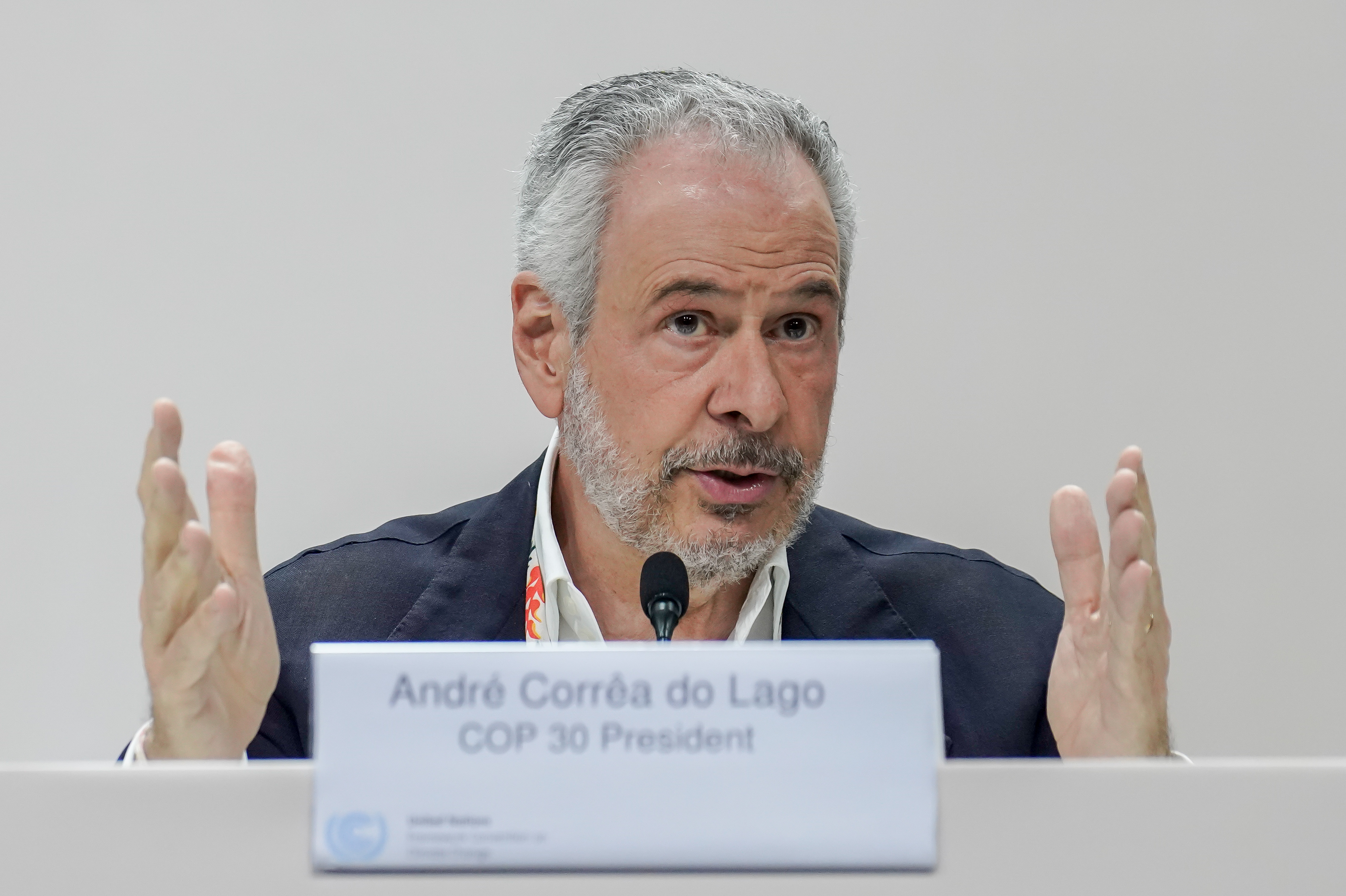
Informal Stocktaking Plenary – November 21 – Video
Check Against Delivery
Good morning.
This is an informal plenary that I will open now.
And as you know, we have a meeting at 11 with the ministers or HODs + one, in the Mutirão room.
So we're going to be able to discuss the many texts that were present.
So, friends, we are here together.
After yesterday's fire at the venue, it was very quickly contained and reminded us of our shared vulnerability and how instinctively we come together to take action in moments of crisis.
I would like to thank all the staff, the volunteers, and the delegates that were amazing for their professionalism and solidarity.
We all received here at the Presidency many messages of support.
Many were very, really very strong and very friendly and sensitive.
But one called my attention, and I quote my friend Mohamed Adow— and I quote him:
“Even in a moment of chaos, one thing stood out. People from every corner of the world, different nations, creeds, and affiliations, looked out for one another.”
Thank you for this message, Mohamed.
This is exactly what characterized our COP when faced with the crisis.
We must respond together.
So I would like to thank all the delegates for the constructive spirit during the consultations that the Presidency led in the last few hours.
We started this year with many geopolitical challenges.
In the context of our regime, the challenges were particularly significant.
The largest world economy exiting the Paris Agreement, a lot of noise about possible additional exits.
At the same time, extreme weather events recalling us that the work we do here is urgent.
The world is watching us.
We arrived in Belém — with Paris reinforced during the months that followed in the mobilization that we built all together to strengthen the regime.
We arrived here with all of you, and we engaged, and we showed the world that this regime has to be strengthened, this regime has to continue, and this regime has already achieved much more than all those who criticize it try to convince the world.
This regime provoked not only the action of countries, the action of cities, but the action of communities, business, technology.
All together is the formula to reach what we really need to do.
For that, we have the policy cycle of the Paris Agreement fully in motion, and we have the determination, and we are conscious of the urgency because we listen to science.
We showed very clearly here in Belém what it means to accelerate implementation, what it means to use the decisions that we have already taken, how to use these instruments to make sure that this regime is understood as one of the most important engines that was ever created to allow international cooperation towards a common good.
But we all know how many obstacles there are to putting words into practice.
And also we all know how difficult it is to reach consensus.
But we can never forget that the same consensus that sometimes exasperates analysts, exasperates delegates, exasperates so many people — that is the strength of this regime.
The fact that we reach consensus is an enormous strength.
We have also to show at this COP that consensus is a strength.
I believe that we are very close to our threefold objective: to strengthen multilateralism, to connect this process to people, and to accelerate the implementation of the Paris Accord.
We know that it is a considerable challenge because at home all our governments face all kinds of pressures.
Electoral pressure, the pressure of fake news, pressures of populations that feel frustrated that we've been 30 years — 30 COPs — and that many, many people don't feel that this regime touched their lives.
But at the same time, by organizing this COP in the Amazon, President Lula wanted the world to see not only the strength and beauty of this amazing Amazon, but also the challenges we have to develop.
Even a middle-income country like Brazil — you see the city of Belém with so many qualities, but also with so many people that still need a lot.
And we, I believe, have changed the perception of the relation between nature and climate.
Thanks to the moments that you all spent here and saw the complexity of dealing with a forest that is not just something that we all instinctively believe we have to protect, but that we need to find solutions for the people that live there.
And we have to make sure that it fulfills its extraordinary role, like the oceans, that we also had very strongly in this COP as regulators of climate.
We saw here at this COP, through the action agenda, so many examples of how, dealing with climate change, we are creating a new economy that offers amazing opportunities for growth, amazing opportunities for jobs.
This is and has to be a positive agenda.
This cannot be an agenda that divides us.
And at the same time that we had to face the fact that the largest economy in the world had left the Paris Accord, we have to remember that we all stayed in because we all believe in it.
We cannot be divided inside the Paris Accord.
We have here a perception of divide that comes from the very negotiation of the Climate Change Convention.
This notion of divide we tried to reduce during these negotiations through transparency and through solutions that would come from the delegations.
And we want to pursue this today to make sure that we find those solutions together, because we all believe that we have to strengthen the Paris Accord.
And we can only strengthen the Paris Accord if we have consensus in Belém.
So let's not stress this divide now, in the moments we have left to reach an agreement.
We need to preserve this regime.
But we need to preserve this regime with the spirit of cooperation, not in the spirit of who is going to win or is going to lose.
Because we know that with the Paris Accord that we fought so much for all those years, if we don't strengthen it, everybody will lose.
Everybody will lose.
And we would show today to those who doubt that cooperation is the best way forward for climate — these are going to be absolutely delighted to see that we cannot reach an agreement between us.
So we must reach an agreement between us.
And you all know that even for the host country, like Brazil, there are very significant challenges, and some of our priorities may not go ahead the way we would like.
But this is not a presidency that is geared towards doing what the host country prefers or favors.
But you have a presidency that favors the strengthening of something that is going to be good for all of us.
So we all have to accept that.
Even if you feel that, “Oh, I won on this,” it is not winning.
It is not winning.
So this Presidency is open — has been during all these months open and transparent.
And in that same spirit is that I want to invite you to the Mutirão meeting at 11h.
That will be in room 22.
That occasion, all delegations will be able to discuss the documents that were circulated early this morning, warning all delegations will be able to approach and negotiate and talk to all the other negotiations — all the other delegations.
So this exercise is an absolutely essential exercise, and this openness and transparency must continue in that meeting.
That, as I said, is going to be for ministers or HODs + one, in room 22.
So I am looking forward to the discussions we're going to have now, and I trust that we will do what we need to do to strengthen Paris — celebrate the 10 years of Paris — by showing we can have consensus and that we are much, much stronger than all those who say that this process cannot go ahead.
Thank you very much.