

President Lula brings the legacy of Belém to COP31, urging world leaders to restore climate action to the global agenda
At the Antalya Leaders’ Summit, Brazil’s President presented five messages for advancing international climate cooperation, called for the implementation of the COP30 Roadmaps, and reaffirmed Brazil’s leadership in protecting tropical forests
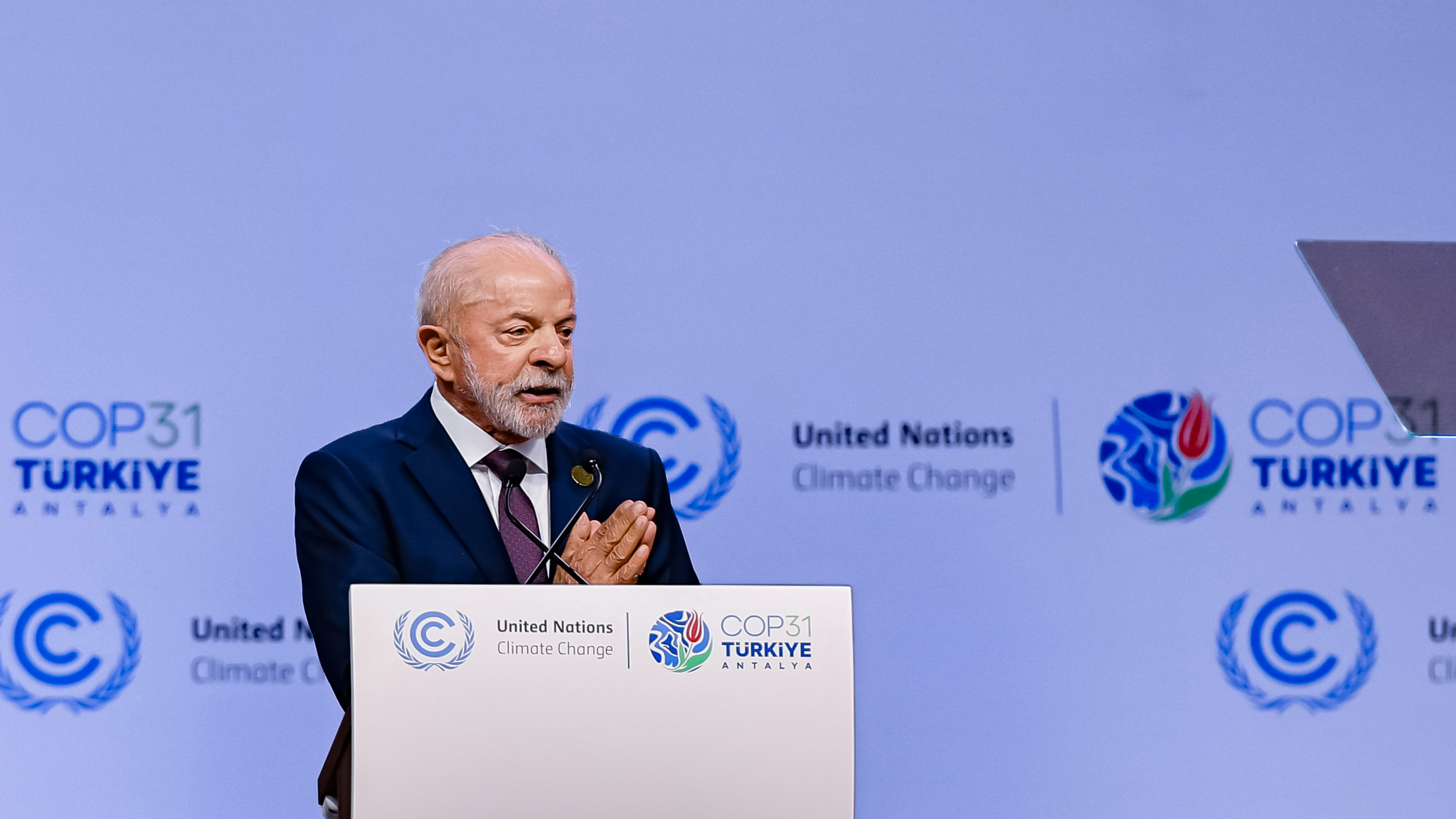
Brazilian President Luiz Inácio Lula da Silva took the stage at the opening of the COP31 Leaders’ Summit on Wednesday in Antalya, Türkiye, carrying forward the legacy of COP30 in Belém and calling on world leaders to restore climate action to the center of the international agenda.
One year after hosting COP30 in the the Amazon, President Lula returned to the international climate stage with five messages grounded in initiatives advanced by Brazil, ranging from climate finance and the transition away from fossil fuels to forest protection and international cooperation. His presence underscored Brazil’s continued engagement in climate diplomacy and its commitment to translating the decisions and momentum generated in Belém into concrete action.
The President recalled the unprecedented participation of Indigenous Peoples, traditional communities and civil society at COP30, where countries recognized the need to move from negotiations to implementation. He warned, however, that geopolitical tensions, conflicts and trade disputes have weakened the momentum for climate action.
"On the journey from Belém to Antalya, that momentum has faded," Lula said, calling attention to the absence of climate change from recent discussions among major global powers. "The planet cannot be left at the mercy of hegemonic disputes," he warned.
Reaffirming the importance of science, multilateralism and the Paris Agreement, Lula emphasized that the absence of consensus should not prevent countries from moving forward. "In times of polarization, diplomacy must know how to open windows where doors close."
Five messages from Brazil to the world: the centerpiece of Lula’s address reflects Brazil’s contributions to international climate action and the implementation of the Paris Agreement.
1. Turn the three Roadmaps inherited from Belém into action. Lula highlighted the importance of the Baku to Belém Roadmap to 1.3T, developed jointly by the COP29 and COP30 Presidencies, and the two international Roadmaps developed by the COP30 Presidency on transitioning away from fossil fuels and halting and reversing deforestation and forest degradation by 2030.
"These Roadmaps will help the world accomplish essential tasks: ensuring that climate finance reaches $1.3 trillion per year; promoting the transition from fossil fuels to other energy sources; and halting and reversing deforestation."
He directly appealed to the incoming COP31 leadership:
"We are counting on the leadership of Türkiye and Australia to ensure that the recommendations contained in these documents are disseminated and incorporated into the next Global Stocktake."
President Lula also reaffirmed Brazil’s commitment to developing national roadmaps to reduce dependence on fossil fuels and eliminate deforestation and forest degradation, alongside sustainable investment platforms that mobilize public and private capital.
2. Expand the Tropical Forest Forever Facility (TFFF). President Lula highlighted the innovative financing mechanism launched in Belém as an example of how political determination can generate new solutions for protecting tropical forests. He called on additional international partners to support the TFFF and help bring it into full operation.
3. Raise ambition and accelerate emissions reductions. Warning that current national climate commitments remain insufficient to meet the Paris Agreement’s temperature goals, Lula called for stronger mitigation efforts and faster energy transitions. He highlighted opportunities to advance electrification, reduce waste and expand sustainable fuels.
4. Protect forests as a global climate priority. Lula reaffirmed Brazil’s commitment to ending deforestation and restoring ecosystems. He highlighted historic reductions in forest loss across Brazilian biomes, including an approximately 71% decline in Amazon deforestation between 2022 and 2026.
5. Strengthen international cooperation for the Amazon. The President pointed to the revitalization of the Amazon Fund as evidence that international partnerships can deliver measurable benefits for communities. The Fund has supported projects benefiting three out of every four municipalities in the Brazilian Amazon.
Together, the five messages reinforced a central proposition of Brazil’s COP30 Presidency: international cooperation must deliver concrete results, while recognizing national circumstances, development needs and the principle of common but differentiated responsibilities.
Forests Leaders’ Summit: From the first declarations to implementation
Later today in Antalya, President Lula brought this message to the Leaders’ Summit on Forests, placing tropical forest countries at the center of the international discussion on conservation, restoration, sustainable development and finance. "This Leaders’ Summit is special because it crowns an unprecedented process for tropical forest countries," he said.
President Lula traced the origins of this effort to 2023, when Brazil convened the Amazon Cooperation Treaty Organization Summit and, together with the Republic of the Congo, the Democratic Republic of the Congo and Indonesia, signed the United for Our Forests declaration.
At COP28 in Dubai, countries agreed on the need to halt and reverse deforestation and forest degradation by 2030. In Belém, at COP30, the Brazilian Presidency undertook the development of an international Roadmap to help translate that commitment into action. The Roadmap was presented in November 2026, ahead of COP31.
"We are following a path that places tropical forest countries at the center of global climate decisions. No longer as part of the problem, but as protagonists," Lula declared.
The COP30 Presidency Roadmap on Enhancing Efforts Towards Halting and Reversing Deforestation and Forest Degradation by 2030 provides a practical framework for strengthening national efforts, international cooperation and financing to protect, sustainably manage and restore forests.
At the Summit, Lula emphasized that conservation and economic development must advance together, recognizing the needs of the approximately 50 million people living in the South American Amazon.
"We know what needs to be done: recognize the value of standing forests and the people who preserve them; put an end to devastation; and restore degraded areas."
He identified three principal challenges to achieving these goals: overcoming poverty, mobilizing adequate finance, and strengthening political leadership.
Brazil's commitments: From conservation to restoration
Lula presented Brazil’s national experience as evidence that determined public policies, social participation and international cooperation can deliver results.
He announced that Brazil would present its National Roadmap to Halt and Reverse Deforestation and Forest Degradation by 2030 at COP31, building on existing policies for forest protection, restoration, sustainable production and the bioeconomy.
Brazil’s recent results include:
A reduction of approximately 70% in Amazon deforestation and nearly 50% in the Cerrado between 2022 and 2026.
An additional 2.5 million hectares of protected areas and the official recognition of 20 Indigenous territories since 2023.
The recovery of 4.5 million hectares of degraded soils and pasturelands, toward a target of 40 million hectares over ten years.
Amazon Fund-supported projects reaching 75% of Amazonian municipalities, strengthening conservation and sustainable development.
The President also highlighted Brazil’s efforts to transform the Amazon’s former "Arc of Destruction" into an "Arc of Restoration," with forest restoration, agroforestry systems and new economic opportunities for local communities.
TFFF: Mobilizing finance to keep forests standing
A central focus of the Summit was the Tropical Forest Forever Facility (TFFF), a flagship initiative launched at COP30 in Belém to create long-term financial incentives for countries that conserve their tropical forests.
Lula announced that the TFFF had mobilized US$7.8 billion from international partners, with endorsements from 66 countries and the European Union, including countries accounting for approximately 90% of the world’s tropical forests.
Unlike traditional aid mechanisms, the TFFF is designed to mobilize public and private investment, generate financial returns for investors, and provide sustained resources to countries protecting their forests, in accordance with their national priorities.
"The operationalization of the TFFF will make it possible to turn commitments into concrete results," Lula said, inviting additional partners to join the initiative.
Looking ahead to the United Nations Decade of Afforestation and Reforestation, from 2027 to 2036, the President called for renewed political determination, stronger international cooperation and financial resources commensurate with the scale of the challenge.
His message in Antalya reaffirmed Brazil’s ambition to connect forest conservation, economic prosperity and social inclusion, while helping accelerate global implementation of climate commitments. "Count on Brazil," President Lula concluded.
Read the full speech at the Antalya Leaders’ Summit (in Portuguese)
Read the full speech at the Leaders’ Summit on Forests (in Portuguese)