

Trade and Climate Must Go Hand in Hand to Accelerate Implementation of the Paris Agreement
Integrating trade and environmental policies is essential to scaling up low-carbon solutions, preventing new trade barriers, and ensuring that developing countries benefit from the energy transition
The global transition to a low-carbon economy requires profound changes in how the world produces, invests, transports, and trades goods and services. While climate negotiations aim to reduce greenhouse gas emissions, implementing these commitments also depends on international trade.
This was the starting point for a high-level meeting held today at COP31. Representatives of governments, the World Trade Organization (WTO), and the COP30 Presidency discussed how to bring the two agendas closer together to translate commitments into concrete results.
The relationship between trade and climate still faces significant challenges, including a lack of coordination among the institutions responsible for policymaking. WTO Director-General Ngozi Okonjo-Iweala pointed out that environment and trade ministers rarely participate in the same discussions. As a result, measures designed to reduce emissions may have unintended trade consequences or be perceived as protectionist instruments.
The goal should not be to prevent countries from adopting their own climate policies, but rather to promote interoperability across different systems. Harmonizing criteria and strengthening dialogue among governments can reduce costs, provide greater regulatory predictability, and prevent environmental measures from becoming trade barriers.
“At the WTO, what we are trying to say how can we make those approaches interoperable so that if you're a business, especially a small business, trying to trade somewhere, you don't have to deal with so many different standards of carbon, how you account for the carbon in your goods, the payment, and so on,” said Okonjo-Iweala.
COP30 President André Corrêa do Lago emphasized that climate action requires the engagement of different areas of government. Brazil's experience, he said, has demonstrated the importance of coordination among finance, environment, and foreign affairs ministries, an approach that must also extend to trade. “And the truth is that in all countries, it’s different ministries that negotiate, and it’s different ministers that implement,” he said.
In this context, the establishment of a dialogue forum on trade and climate, as provided for in the COP30 Global Mutirão Decision, with discussions initiated in Bonn in June, offers an opportunity to develop a common language and bring the two processes closer together.
“When a minister of environment of any of our countries goes back to the capital after the COP, the ministers of environment don’t have the power to have an influence on all the other ministries at home,” Corrêa do Lago said. “You need the ministry of infrastructure, the ministry of transportation, the ministry of trade, the ministry of agriculture.”
Transition Must Be Just and Inclusive
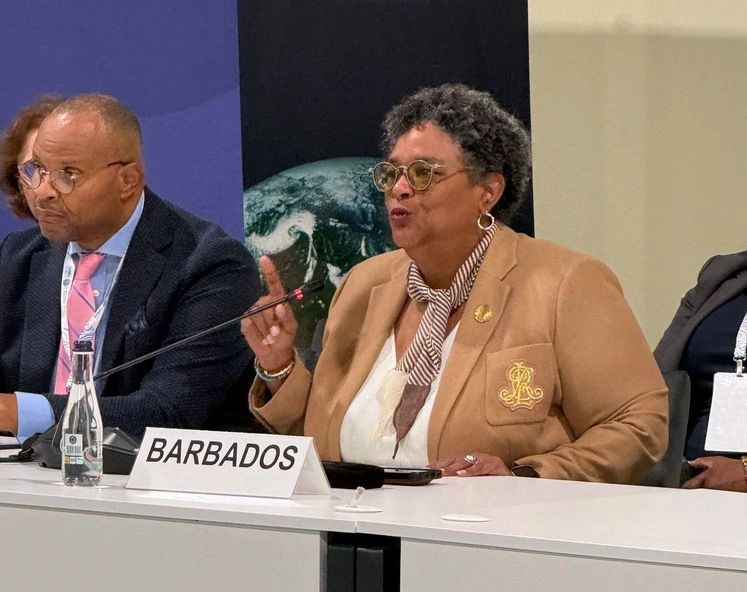
Integrating trade and climate policies must also take into account differences in countries' capacities. Barbados Prime Minister Mia Mottley warned that small states face significant challenges in accessing the technologies and financing mechanisms needed for the energy transition. Without long-term financing on terms suited to the investments required, many countries struggle even to advance their own economic transformations.
Mottley also drew attention to middle-income countries that are particularly vulnerable to the impacts of climate change. These countries do not receive the same special and differential treatment afforded to least developed countries, despite facing significant climate risks.
“We fail to recognize that none of these countries has the capacity to distort either the global trading system or the global financial system,” she said. “The reality is that when you say to a country, ‘Pay higher interest rates because you are a higher risk, or because you are falling,’ you’re effectively asking them to go deeper into a hole and precluding opportunities they might otherwise have in other areas, because we don’t live in a single-crisis world. They face other polycrisis moments that require funding and attention.”
The Prime Minister called for closer coordination between the international trading system and international financial institutions. Access to more affordable financing and resilient fiscal space is essential to enabling these economies to implement climate policies without compromising other development priorities.