

One year on, the Belém Declaration on Hunger and Poverty brings together 50 countries and advances national social protection plans
At an event at the Brazil Pavilion, the COP30 Presidency and partners discussed how to get climate finance to those who need it most through adaptive social protection for climate resilience
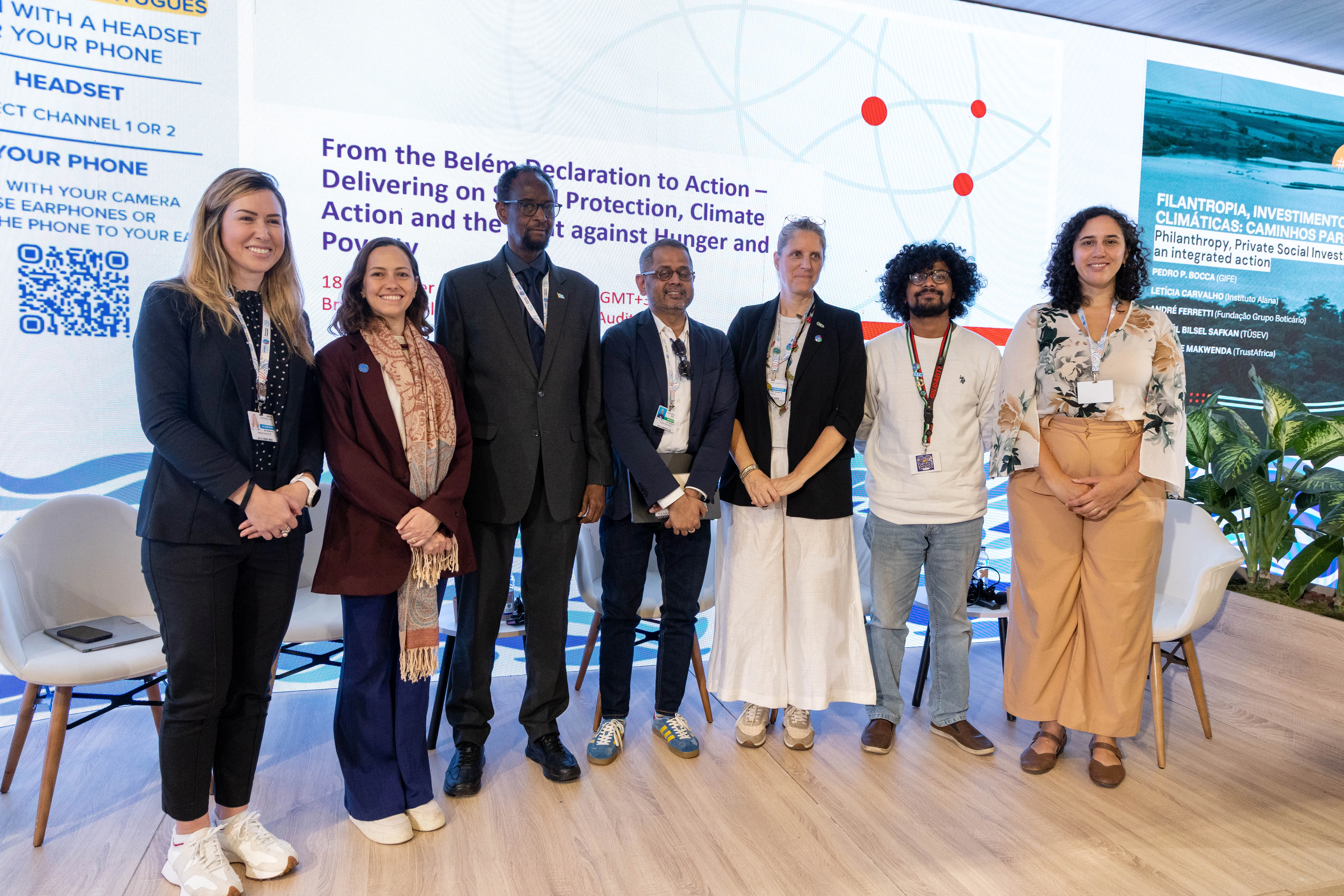
One year after its launch at COP30, the Belém Declaration on Hunger, Poverty and Human-Centred Climate Action was the focus of an event on Wednesday, 18 November, at the Global Mutirão Auditorium of the Brazil Pavilion, in the COP31 Blue Zone. Organized by the Global Alliance Against Hunger and Poverty and the Task Force on Linking Adaptive Social Protection and Climate Financing, with the participation of the COP30 Presidency, the event brought together governments, development banks, multilateral climate funds and international organizations to take stock of progress and identify ways to scale up climate finance for social protection.
COP30 Action Agenda Director Bruna Cerqueira recalled that the Brazilian Presidency included the fight against hunger and poverty among the Action Agenda’s 30 objectives, as Objective 17 – Reducing the effects of climate change on eradicating hunger and poverty. “For us, it was crucial to have this space. And now that space is ingrained in the Action Agenda structure, so it continues over time. It gives us a space to keep this agenda going year on year,” she said.
This choice reflects a message the COP30 Presidency has reinforced from the outset: moving from commitments to implementation, with results that reach people. As climate change disproportionately affects the poorest and most vulnerable, COP30 President Ambassador André Corrêa do Lago has called on everyone to put people at the centre of climate action and to tackle structural inequalities, both in the Action Agenda and in the negotiations.
Data compiled in the 2026 Yearbook of Global Climate Action for this objective show progress. Extreme poverty is expected to fall from 831 million people in 2025 to 811 million in 2026, and the number of people facing hunger fell from around 659 million in 2024 to around 645 million in 2025. It remains unclear, however, whether these gains reflect lower climate vulnerability.
Since COP30, endorsements of the Belém Declaration have grown from 43 to 50 countries. Under the Plan to Accelerate Solutions (PAS) linked to the Declaration’s implementation, three of the implementation plans prepared by Cuba, Ethiopia, Kenya and Zambia with support from the Global Alliance have been approved. The initiatives combine water access, local food systems, livestock resilience and cash transfer programmes, and are expected to benefit nearly 5.5 million people.
Birgit Pickel, Director General for Sustainable Development and Climate at Germany’s Federal Ministry for Economic Cooperation and Development (BMZ), who has chaired the Task Force since earlier this year, highlighted the role of the Declaration. “Under the leadership of the Global Alliance and with support from the Task Force, the Declaration was a major milestone. It marks a clear political commitment to place hunger and poverty eradication at the heart of climate action. We are really grateful to our Brazilian partners and colleagues who led this effort,” she said. According to Pickel, the Declaration rests on three pillars: strengthening social protection, supporting small-scale food producers and promoting just transitions.
The panel brought together Somalia, the Asian Development Bank, the Green Climate Fund and a UNICEF Youth Ambassador. Participants discussed how to overcome the barriers that keep climate finance from reaching country-led social protection programmes, especially in fragile contexts, and how to involve young people in designing these policies.
Launched during Brazil’s G20 Presidency, the Global Alliance Against Hunger and Poverty now has 222 members, including 107 countries. The Task Force was created in 2024 by BMZ and brings together climate funds, development banks and UN agencies. At COP30, it launched a joint guidance note on social protection and climate finance with five multilateral climate funds. Its experience now also feeds into the newly established Global Social Protection Expert Desk for Risk Response, which will provide technical advice to countries in risk-prone and fragile contexts.