

“Every country can start now”: Ana Toni presents COP30 Roadmap to the Santa Marta process
At COP31 in Antalya, the CEO of the COP30 Presidency highlighted how the document provides a common language and shared indicators to help countries with different starting points move forward together toward the second Global Stocktake
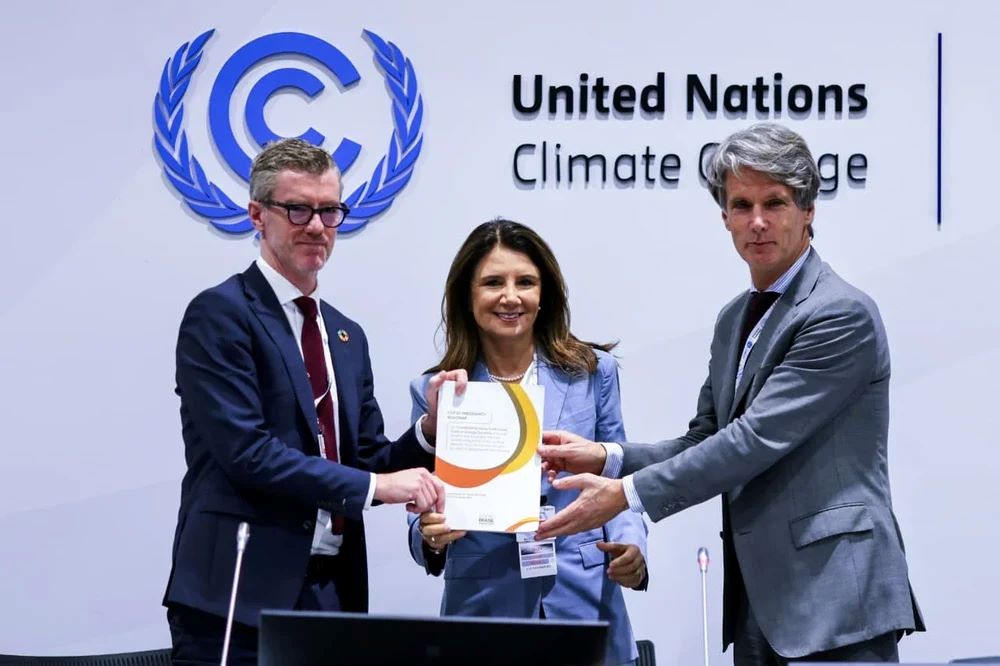
The COP30 Presidency presented its Roadmap for Transitioning Away from Fossil Fuels in Energy Systems in a Just, Orderly and Equitable Manner to representatives of the Santa Marta process on Monday, November 16. The Roadmap was formally handed over by Ana Toni, CEO of the COP30 Presidency, during the ministerial event From Santa Marta to GST2: Delivering the Transition Away from Fossil Fuels, held at COP31 in Antalya, Türkiye.
The Santa Marta process emerged from the First Conference on Transitioning Away from Fossil Fuels, co-hosted by Colombia and the Netherlands in April 2026 in the Colombian city of Santa Marta. The conference brought together 57 countries representing approximately one-third of the global economy. The second conference, scheduled for 2027, will be co-hosted by Tuvalu and Ireland.
“We used a lot of what was produced in Santa Marta in our Roadmap,” said Ana Toni. Released in early November, the document was officially presented at COP31 on November 10, with the participation of UN Secretary-General António Guterres. Toni reaffirmed that Brazil will participate in the next conference.
The event was organized by the International Institute for Sustainable Development (IISD), in partnership with the Government of the Netherlands and the organizations Transforma, FARN, INESC and South Centre. Ministers and officials from Tuvalu, Belgium, the Netherlands and Ireland, as well as the Inter-American Commission on Human Rights (IACHR), discussed how redirecting public financial flows, including fossil fuel subsidies, and addressing fiscal and debt constraints can help turn transition commitments into action ahead of the second Global Stocktake (GST2).
A common language, different starting points
Ana Toni recalled how discussions on transitioning away from fossil fuels have gained prominence at UN climate conferences. According to her, there were only seven events on the topic at COP26 in Glasgow, compared with 82 at COP31. “No one is going to stop us from discussing these issues wherever we want, especially here at the UNFCCC,” she said.
The Roadmap is the result of a commitment undertaken by the COP30 Presidency following the conference in Belém last November. Its purpose is to provide a common language and shared indicators to assess whether countries are moving in the same direction. Rather than examining countries individually, the document uses archetypes: producers and exporters, consumers, economies dependent on a single fossil fuel commodity, and diversified economies. “Every country can do something to transition away from fossil fuels, and can start now,” Toni said.
The proposed first step is for each country to assess its own dependence on fossil fuels, whether as a producer, exporter or consumer. “If you don’t know how dependent you are, you don’t know what you need to do next,” she said.“My dream is for every country to conduct its own assessment and understand its dependence on fossil fuels, whether using the methodology proposed in our Roadmap or any other. That way, we can arrive at GST2 with a much clearer understanding of what we want from that process.”
Toni also advocated for a “basket” of measures accessible to all countries, including assessments and the capacity to generate data on subsidies, with technical assistance for developing countries. She congratulated countries that have already presented national roadmaps, including the Netherlands, Sweden, France and Germany, and expressed hope that many others would arrive at COP32 in Ethiopia with their own transition pathways.
From Santa Marta to Tuvalu
The panel moderator, IISD President and CEO Patricia Fuller, emphasized that the Roadmap provides “a common vocabulary, a common framework” for discussing the transition while recognizing that countries have different starting points.
Tuvalu's Minister of Home Affairs, Climate Change and Environment, Maina Vakafua Talia, will chair the second conference. According to him, the central question will be a practical one: what is preventing the world from making the transition, and what can countries do together to overcome those barriers? “The Roadmap presented by the COP30 Presidency is a compass pointing towards a common horizon,” he said.
Representing Ireland, which will co-host the conference, Philip Nugent, Director General at the Department of Climate, Energy and the Environment, argued that the transition should also be approached as a strategy for competitiveness and economic sovereignty. He praised Brazil's “extraordinary work” and encouraged future COP Presidencies to build on it.
Belgium's Minister of Mobility, Climate and Environmental Transition, Jean-Luc Crucke, identified transparency as the foundation for subsidy reform, noting that the Belgian government publishes an annual inventory of fossil fuel support measures. The Netherlands' Climate Envoy, Jan Versteeg, shared lessons from the Santa Marta Conference and the Dutch experience with energy efficiency.
Javier Palummo, Special Rapporteur on Economic, Social, Cultural and Environmental Rights at the Inter-American Commission on Human Rights (IACHR), emphasized that human rights must be at the center of fiscal and financial policies supporting the transition.
Next steps
The Santa Marta process now moves toward its second conference in 2027. The main conference will take place in Tuvalu, while Ireland will host a preparatory segment. In the meantime, the three workstreams established in Santa Marta—national roadmaps; finance and macroeconomic dependencies; and trade-related aspects of the transition—will continue gathering experiences and solutions to inform the second Global Stocktake.
By formally presenting its Roadmap, the COP30 Presidency reaffirmed its commitment to supporting the Santa Marta process. “We need to bring this issue to every Climate Week and discuss it at the national level so that it does not become a taboo. This must be a conversation that keeps moving us forward,” Ana Toni concluded.