

At COP31, the Global Ethical Stocktake brings society’s voice into assessing progress on climate goals
In a panel discussion at the Brazil Pavilion, partners of the initiative explored how people’s lived experience and knowledge can inform the assessment and implementation of the Paris Agreement
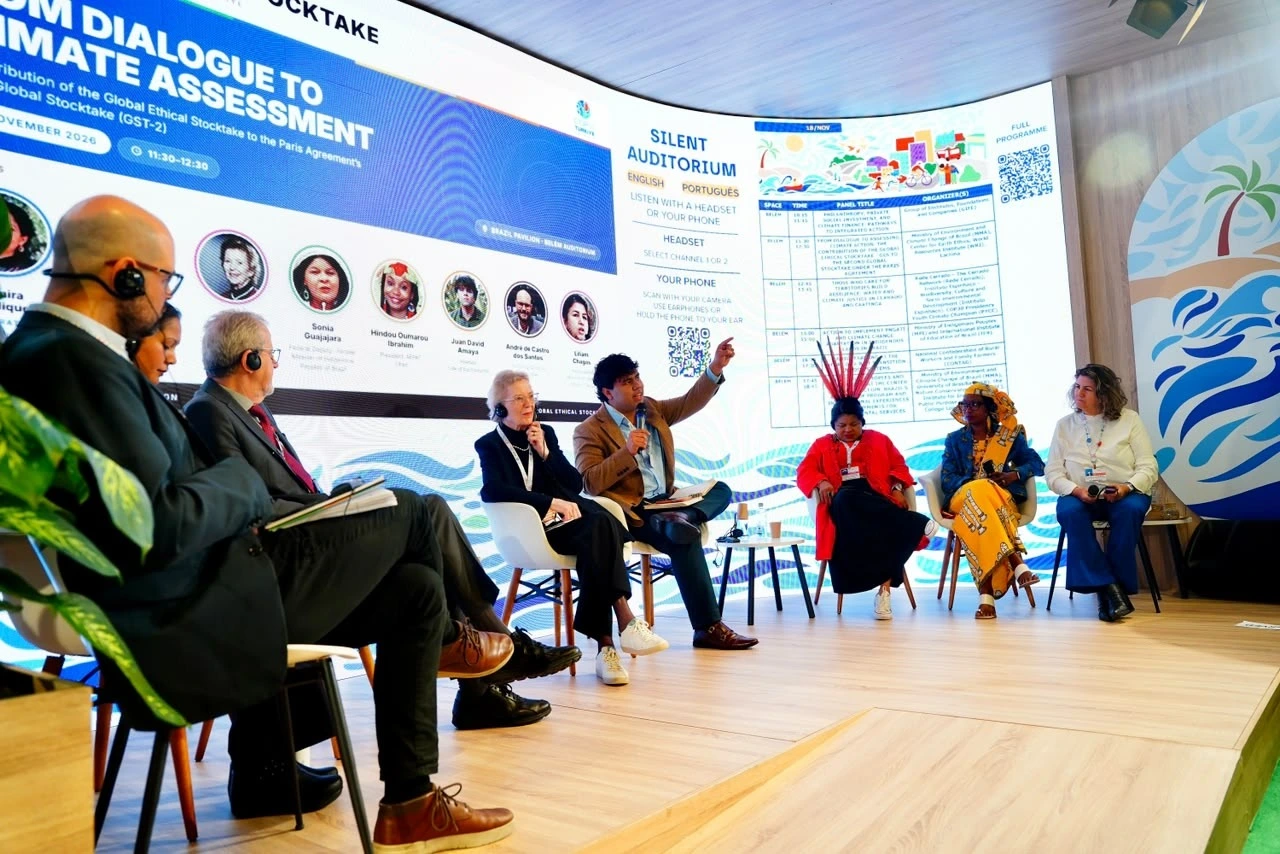
Bringing society’s experience and knowledge into the assessment of global climate action was the focus of a panel on the Global Ethical Stocktake (GES) held on Wednesday, 18 November, at the Brazil Pavilion in the COP31 Blue Zone in Antalya. Organized by the Center for Earth Ethics, the World Resources Institute (WRI), LACLIMA and Brazil’s Ministry of the Environment and Climate Change (MMA), the session explored how contributions from across society can strengthen implementation of the Paris Agreement and feed into the second Global Stocktake (GST2), which will assess countries’ collective progress towards their climate goals.
Launched by President Lula and UN Secretary-General António Guterres, with support from the COP30 Presidency, the MMA and Brazil’s Ministry of Foreign Affairs, the GES is driven by a central question: if we already know what needs to be done to tackle the climate crisis, why aren’t we doing it? In 2025, the initiative held six regional dialogues, with 128 participants from 49 countries, and 125 self-managed dialogues involving nearly 13,000 people in 43 countries. Their findings are brought together in the GES Global Report.
Opening the panel, Samira Siddique of the Center for Earth Ethics summed up the challenge that inspired the initiative: “We have the science, we have the policy frameworks, yet we are missing something that is fundamental, which is the transformation of the values that shape our relationship with one another and with the living world.”
The GES looks beyond whether climate action is progressing to ask whose rights, knowledge and priorities are reflected in decisions, and whether the benefits and burdens of implementation are being shared fairly. By connecting society’s perspectives with governments and negotiating processes, it offers an ethical lens that complements the technical assessment under the Paris Agreement.
The initiative has now entered a new phase, formalized during Climate Week NYC in September. Karenna Gore, who co-led the North America Dialogue, now leads the GES Executive Secretariat, while Brazil is spearheading efforts to engage other countries and broaden support for the initiative. “We want to make sure that these ethical principles are fed into the second Global Stocktake, which will culminate in 2028, at COP33,” said Samira Siddique. She explained that the institutional track is being led by the COP30 Presidency and the MMA, in dialogue with Parties, while a parallel civil society mobilization, led by the regional co-leader teams, aims to ensure that grassroots movements continue to drive ethically grounded climate action.
Brazil’s Minister of the Environment and Climate Change, João Paulo Capobianco, also took part in the panel. The MMA has been convening a series of high-level conversations with countries and civil society to put ethics at the heart of the climate regime. At one of these meetings, held earlier at COP31, the Minister called for the debate to go beyond the negotiations: “This is not a convention about climate change; it is a convention of human and non-human beings in the face of this change.”
GST2 offers a strategic window for this agenda, with the call for submissions open until February 2027. Before then, further conversations with countries and civil society are expected to help build common ground on responses, so that key ethical language finds its way into the GST2 synthesis report.
The GES Global Report, which brings together lessons from dialogues across all six world regions, is available here.